Tuesday, 20 October 2015

What makes Sehwag special

The long list of retiring legends continues to grow - so much so that, come next month, the world will see a "Legends' T20 League". But no man in cricket has enthralled me the way Virender Sehwag did. As blasphemous as this may sound, at one point in time, it was Sehwag's dismissal that made me switch off the television and not Tendulkar's. Every time India won or lost the toss and had to bat second, I'd be dismayed that entertainment was postponed.

But what made Virender Sehwag so particularly special (in fact, even endearing) to me? Numbers certainly speak and like all legends, Sehwag had them. After 104 Tests, Sehwag retires with over 8500 runs, scored at just under 50 per innings and over 80 per 100 balls. In 251 ODIs, Sehwag plundered 8273 runs, scoring faster than run-a-ball for nearly 14 years. But numbers in sport only go so far. None of them account for the nonchalance of one of the most charismatic cricketers of all time, who presented a refreshingly candid face to the public, in an era of much pretense and 'political correctness'.
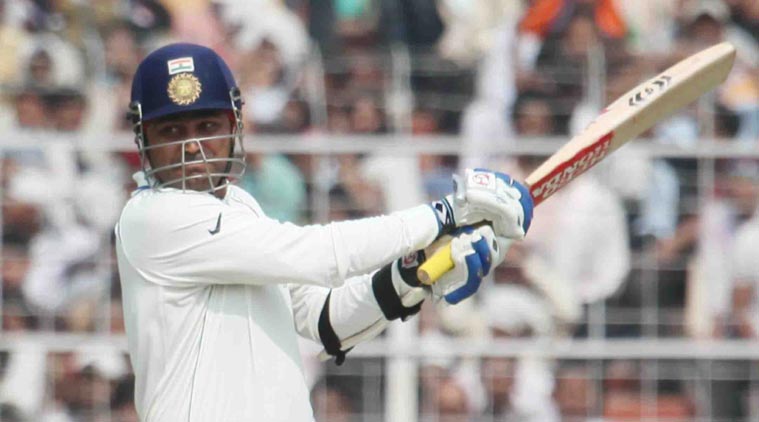
Pioneer: Sehwag had a "don't try this at home" style of  living
Perhaps the greatest of Sehwag's qualities was his undying belief in his own unconventional ways. In his statement following retirement, Sehwag apologizes to all those whose "advice" he conveniently discarded, for he "did [things his] way". His coaches know that well. Greg Chappell once wrote that Sehwag was the most talented and yet the most frustrating player he'd ever coached. Chappell wrote that if Sehwag did follow time-tested techniques, he'd likely have been greater than even Tendulkar himself. That is speculative, but what Chappell didn't see was that Sehwag's originality is what made him great, and Sehwag, for one, knew it well. The world works on conventions. Every walk of life has its own myriad procedures and processes, schooled to those in its field and practiced religiously by most. But conventions also make men predictable. A conventional human being is the easiest to defeat, for he can't outwit or surprise you. Little surprise then that the pantheon of greats in any field of life is populated by the rebellious few. Albert Einstein was thrown out of school for his 'inability to perform'. Steve Jobs was cast out of his own company for his lack of  'managerial skills'. Walt Disney was shunted out of his first job for his 'incompetence'. And Virender Sehwag was often ostracized for his disdain towards 'batting technique'.

Yet, Sehwag did play, and built an extraordinary career at it too. Pundits believed that Sehwag was a slugger, meant, if anything, only for the fast-paced life of limited overs cricket. But it was in Tests that he chose to prove them wrong. He is one of only 4 men to have scored 2 triple hundreds in Test match cricket and nearly did it a third time, falling after thrashing 290-odd on a single day in the dust bowl of Mumbai (in the post-game presentation later, Sehwag cheekily said that Muralitharan was "out of form", all with a straight face). He averaged over 50 in Tests before it became fashionable and redefined the openers' slot in Indian cricket, inspiring the likes of Shikhar Dhawan and Robin Uthappa to follow.

But everyone would tell you that Sehwag is not to be imitated, and I agree. Like all other great and original men, Sehwag had a way that none should dare to try at home. Many, in fact, have tried to go the Sehwag way in different parts of the world and failed. An arguable exception would perhaps be David Warner - Australia's own 'Sehwag' who broke into the national team in unusual manner (called from the stands in Sydney in fact, to fill in as a substitute just ahead of a T20 game) and continued to play just as unusually with fair amount of success. But even Warner is yet incomparable to Sehwag, for both are original and unique in their own quirky way. Sehwag was known for his unassuming and friendly demeanor on the field, yet Warner is anything but that. Sehwag dominated the opposition with a strangely calm and amicable appearance. Warner often finds it necessary to mouth off at the opposition instead.

But Sehwag wasn't just a legend on the field; he is also an unlikely pioneer in education. Sehwag's new international school near Delhi is a model for the future of schooling in India - mixing quality academic education with world class sporting facilities on campus, all at a subsidized fee. Often in India, students in school have little opportunity to pursue sport seriously enough, unless they're enrolled in expensive convent schools. Sportsmen come from the hinterland, often deprived of quality schooling and unable to find proper coaching or training facilities early in life. Sehwag belonged to the latter category and saw the pressing need to make education meet sport - as his school has done. In the years to come, one can positively hope that the Indian government follows Sehwag's lead in the development of sports across the country, and that Sehwag pursues his vision for the future of Indian sport in his own quirky manner.

Cricket will undoubtedly never be the same without Virender Sehwag, but there are serious life lessons from Sehwag's career for all those who will heed. This was a career dedicated to the rebels who dare to be different, the tenacious who don't bend to convention, "those square pegs in round holes" as Jobs had called them. None will replace him, but many will emulate him.

Thank you for all the inspiration, Viru.

Friday, 13 March 2015

Can Morgan now be the next Dhoni?

English journalists and cricket fans are noisy folks, so you had to expect the barrage that came following England's untimely exit from the World Cup. There was plenty written and said about everyone - from the board president to the former captain, the current coach and of course - that evergreen punching bag of English cricket - Kevin Pietersen. Plenty written and said, but not a word on Eoin Morgan, the man at the helm. The most that one could hear or read about the English captain was how he was the unfortunate scapegoat, thrust at the wheel of a sinking ship.

That Sinking Feeling: Morgan isn't too different from Dhoni
That isn't mere sympathy. Born in Ireland, yet belonging to England, Morgan was yet another of those stolen cricketers who were meant to change the face of English cricket. But even as England's ill-fated World Cup journey was about to begin, few knew if he would truly lead the side. True to their form, the conservative Englishmen stuck steadfast by the side of their conservative skipper, Alastair Cook, even as he took the English team from one defeat to another. Then, just weeks ahead of world cricket's greatest competition, Eoin Morgan was dug out from the cold and put in charge. He did his best, however, in his first real assignment in Australia, leading his side in a triseries that really featured just two teams - the hosts and his own. Then came the World Cup, where, in the words of Steve Waugh, the conservative Englishmen played a brand of cricket more suited to 1989, albeit under the guise of naturally more progressive talent.

Don't forget though that not too long ago, the celebrated Indian team was in the same phase as England are in today. Following the 2007 World Cup, the equally ferocious Indian media wrote pages and pages together about anyone and everyone. In a most recent interview, the captain of the time, the otherwise unflappable Rahul Dravid said of the experience that "captaincy wasn't what I thought it would be. It was more about personalities and less about cricket." Dravid said that he soon grew tired of leadership and handed it down to an individual he thought was ready for the job and hungry for it.

In the months that followed, the face of Indian cricket changed entirely. MS Dhoni, still relatively new to international cricket himself, took India to a most famous T20 championship victory in South Africa, and soon followed that up with history in different parts of the world. India later went to the summit of world cricket - in all formats - and stayed formidable for a fairly long time.

It isn't that MS Dhoni hasn't had failures. He once lost 8 Test matches in a row outside of India and, eventually, himself "grew tired" of leadership in the longest format. In the ODI triseries that preceded this World Cup, India were rolled over, failing to win a game, despite spending enough time in Australia to even learn its geography in good detail. Yet, such is the nature of success and failure, that one can easily overshadow the other, in quick time. India can now do no wrong and the captain himself is unsure about how this phoenix-like transformation came about.

Morgan is not too different from MS Dhoni. Both are equally likable - daring, innovative, diplomatic and yet, candid, frank and reserved by nature. So could Morgan now become England's Dhoni? The greatest challenge that leaders face when they take over in times of tumult is dealing with uncertainty and loneliness. No one gave Dhoni a chance when he first came in. Even his place in the team was under doubt. Whether a junior cricketer would be able to handle the personalities whom the great Rahul Dravid himself could not deal with was yet to be seen. But introverts like MS Dhoni and Eoin Morgan have a gift - they tend to isolate themselves from the world that gobbles up most, thereby making them great shock-absorbers - a quality seen most visibly in folks whom pundits call 'great finishers'. Yet, spare a thought for the man from Ireland who must now reform the conservatives of the UK. He now needs to turn into a political statesman as well.

Wednesday, 31 December 2014

The man who sculpted Indian cricket

Mahendra Singh Dhoni has always had a unique fancy - he likes to develop individuals and careers. For the most part of his career as captain of the Indian cricket team, Dhoni spent time in 'throwing the long rope', hoping the man at the other end of it would grab on and climb up. It was only fitting then that the skipper stepped down as captain at a time when he felt his ward had grown confident enough to take on the mantle.

Criticize his captaincy all you like; you still can't overlook the fact that he's among India's most successful. There was a time when MS Dhoni was the world's best batsman, keeper and captain - separately and together. Not to mention, he is, today, and has been for most part of his career, arguably the most stressed out sportsman in the world. Roger Federer feels the pinch of expectations, but that's an individual sport; you can always turn a deaf ear to the critics. Perhaps Lionel Messi, who always seems a different player when he's in Argentina's blue and white? No, Messi rarely ever plays for Argentina, unlike Dhoni who plays all year round. As hard as one can think, it's near impossible to find an athlete even in today's mad world who needs to answer a billion people, lives in front of the cameras everyday and plays three roles in one, all year round. Yet, so does Dhoni.

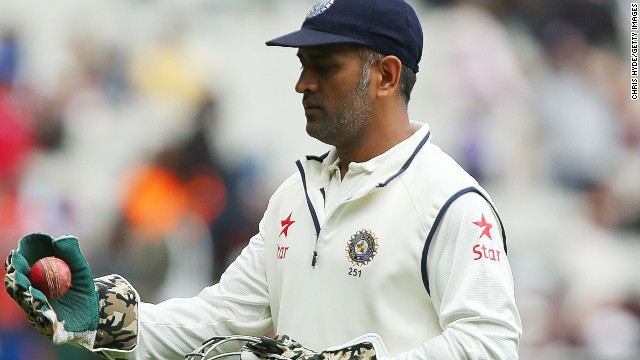
The Sculptor: Dhoni is world cricket's greatest statesman
But what's MS Dhoni's greatest legacy as a Test captain? Was it the day he defeated Sri Lanka at home to take India to the summit of Test cricket for the first time in history? Or is it his invincibility at home that has done enough to overshadow his overseas vulnerabilities and make him the most successful captain in Indian Test history? Neither, I say. It's his ability to sculpt careers and individuals. The best of leaders aren't those who pile up stats and factoids; they are those who build individuals, societies and nations. Think of Abraham Lincoln, the man who held America together even while its economy wasn't as large and dominant as it is today. Or think of Martin Luther King, the man whose immortal words continue to inspire, despite the difficulties that his community faced back in his day. Closer to the cricket field, think of Steve Waugh, the man who built, by the sweat of his brow, the most legendary playing squad cricket has ever seen.

It is therefore that I prefer to weigh the contributions of MS Dhoni, not by his win percentage, but by his handling of a team that was under transition. When India became the best Test team in the world, it had the services of legends like Dravid, Tendulkar and Laxman. Dhoni's true test began when the legends stepped down. In my view, he came up trumps. On innumerable occasions, critics (me included) questioned his unwavering faith in a handful of young men, even as they stumbled and failed. Rahane, Kohli and Rohit Sharma all had forgettable starts to their career. Yet, Dhoni threw them the 'long rope'. It took ages before the rope was finally accepted and his wards started finding their feet. While at one point in time India's young batsmen barely managed 200 in overseas Test innings, they now cross 400 far more consistently. That is a telling tale.

Unfortunately, while he was immersed in fixing the batting, Dhoni let the bowling slip. Ishant Sharma seems a fair exception - yet another example of a young man who held on to the 'long rope'. But by and large, India's bowling attack today is probably the worst in the world, outside of Bangladesh and Zimbabwe. That has hurt Dhoni's ability to win overseas Test matches. Batsmen can win you one-day games and T20s. The best they can do in a five-day game is secure a draw. No side wins, or deserves to win, unless it takes 20 wickets. Many would point out Dhoni's perceived lack of aggression in Test match cricket. But one can't have a heavy slip cordon or men in catching when the bowler lacks control over the ball.

But perhaps Dhoni's greatest quality of all is his statesmanship. In a country like India, diplomacy and statesmanship is a hard game. A billion people are watching you keenly all the time. But Dhoni, to his credit, hasn't been unduly noisy, keeping pesky journalists where they deserve to be and locking up dirty linen in the most obscure cupboard. We Indian citizens love noisy cricket captains, news anchors and Prime Ministers. But seldom do we remember that noise is not an integral part of game plans, television debates or government policies. Noise tends to fire people up, yes; but people who are fired up often set other things on fire. And as is often noticed these days, that is purely destructive.

India's Test team will remember MS Dhoni is a freak. Men like him aren't supposed to succeed at this game. Nor are they expected to be common. When you think of long-time captains, you think of them as folks who just don't look the part while playing under someone else. Just as well, when you think of great team players, you never imagine them as great captains. But Dhoni was a rare man who fit remarkably well both as captain and as player. If you ask the young minions he has groomed in this Indian side over the last few months, you'd find that they've just lost a father figure. When Dhoni finally retires from all international cricket, he'd go down in history is a freakish legend, if he hasn't already.

Monday, 3 November 2014

'Home advantage' - way too homely?

"What does one make of Pakistan cricket?" asked a thrilled, yet equally flummoxed Pakistani supporter, after his national team trounced Australia in the Emirates. One might pose that sort of question about anything 'Pakistan'. But here's the cricketing story. Only recently, Pakistan had lost their premier spinner to alleged chucking. On either side of that incident, they kept rotating their captains around like a game of roulette (on one occasion, when Shahid Afridi was asked if he was Pakistan's captain, his reply was "I don't know"). 

But then, all of a sudden, an unknown spinner turned up and proved to be even more lethal than the man he was meant to fill in for. Their captain - their most recent captain at the time of this writing, anyway - a man who had apparently sworn to stonewall his way into retirement, ratcheted up both the fastest 50 and the fastest 100 in one single historic Test innings. And the next thing you know, Australia had been soundly whacked 2-0 in a Test series they never seemed to have turned up for. History was made, and without so much as a fuss. Pakistan had beaten Australia in a bilateral tournament for the first time since 1994.

Home Sweet Home: Conditions were favorable; Pakistan won
It's yet too early to say if Pakistani cricket has really taken off. The only way to describe Pakistani cricket is - 'mercurial'. And nothing mercurial is ever predictable. But the outcome of this series certainly was, at the start. You might not have expected a trouncing of this sort, but everyone knew that Australia were in for a tough time. They were climbing up a hill, Pakistan were strolling along a flat plain. It was all down to 'home advantage'. Sure, this wasn't really Pakistan, but anyone who's been to the UAE would know that that country is nothing but 'little Pakistan'. And to be sure, the pitches were either bone dry or dead flat - nothing like the sort of green meadow Mitchell Johnson would have been hungry for.

Pakistan made good use of 'home' conditions. Much like everyone else in world cricket has been doing of late. Save for Australia and South Africa, who pretty much have similar conditions in their respective countries, every other bilateral series of note in recent times has been woefully lopsided in favor of the home team. India got thrashed in England recently. New Zealand pounded the West Indies at home. India then came back home and walloped the West Indies. And they've only begun their run of carnage on the Sri Lankans now. Pakistan, of course, have now beaten the hapless Australians.

Overall, it's been an absolute carnival for whoever is playing at home - except maybe Bangladesh, but they're yet outside the big league, so they're excused. To the spectator, it has been dour. Odds at the bookie have been discouraging too for those who bet, sensibly, in favor of the home team. Have home conditions gotten far too homely? Or are cricketers just bad tourists and better sightseers in the modern game?

In the previous decade or two, world cricket was used to seeing a dominant bully on the global stage - Australia. Ricky Ponting's Australia were the real deal. Hosts or tourists, setting or chasing, they started favorites, anywhere, anytime. Australia's dominance encouraged sides to push their own bar higher and higher, relentlessly, because the 'Roos could never be caught up with. One of those who greatly benefited from this exercise were Sourav Ganguly's Indian team. Traditionally poor at touring foreign lands, India suddenly found ways to win Test matches in England, Australia and South Africa.

But post 2008, Australia has been on the decline, and there's little doubt about it now, if there ever was. The likes of Matthew Hayden, Adam Gilchrist, Glenn McGrath and Shane Warne were never going to be replaced. Sadly, no one else in the world has really taken up the baton from the Aussies either. While South Africa have shown little glimpses of dominance from time to time, they still are vulnerable in the subcontinent, in a way that Ponting's side seldom was. 

In result, world cricket has turned into a game of quid pro quo - you beat me at your place and I'll beat you at mine. Scheduling has helped too. Teams often play each other back-to-back, once in each side's backyard. Tight schedules further mean that there's little time to spend in adapting to foreign conditions. Series are often restricted to two Tests - fit for a world of business-like globetrotters.

But could pitches be held accountable too? Of late, one gets the sense that 'home advantage' is turning far too skewed. In India, pitches are so flat that no ODI total less than 350 is even worth defending. In Australia, South Africa and England too, pitches have gotten greener and trickier than before - although, admittedly, to a degree lesser than the skew observable in the subcontinent.

There seems no outright reason for the heavy lopsidedness of contests in world cricket these days. Some would even contest that it exists. But there's little doubt, however, that things have gotten terribly dreary and unexciting in the world of cricket.

Wednesday, 20 August 2014

What's the fuss over coaching?

India's last cricketing tour to England saw the visitors slump to a 4-0 blanking. The stats are less unforgiving on MS Dhoni this time; India lost 3-1 (one game drawn). So surely the last tour was more horrendous? No. As painful as 2011 may have been, the Test series this year far supersedes it in agony. For one, this time, India played a team they expect to last. The last squad had several veterans who were on a pre-retirement sojourn. They were respected, but old. These guys are young; they won the Champions Trophy last year in the same country and have made as much money in a few months as their forerunners made in entire careers.

The agony isn't that India lost; it is that India lost meekly. Following the second Test at Lord's, pundits from across the cricketing world hailed India's win as the country's finest ever in overseas conditions. It came on a tough pitch, in the worst of conditions and despite the most unfortunate toss defeat in fresh memory. No one expected the young Indian kids to win that game. But they did, and they did handsomely. Team India's hunger to fight in that game was typified by Ravi Jadeja's belligerent blitzkrieg in the second innings and Bhuvneshwar Kumar's inexplicable batting prowess.

Detached: Fletcher needs to instill commitment in his wards
But all of that was washed away as quickly and astonishingly as it was first produced. The next time India set foot on London, a fortnight or so later, they found themselves playing catch up. England had jumped to a 2-1 lead from 0-1, and half a captain, down. The preceding game had ended in just under three days. India had won as many sessions since Lord's as England had won Test matches.

Nothing changed in the last three days of the series. In five sessions of play, England had completed the most dramatic turnaround in Test match cricket for as far as the mind can recall. Their captain was now the toast of the town. A monster by name 'Moeenalitharan' was doing its rounds in cricket clubs all across England. And little-fancied Jos Buttler had successfully cemented his place as England's first-choice wicketkeeper (God save Matt Prior now).

There are two things particularly disconcerting about India's abject surrender to England on either side of the day commemorating the former's independence from the latter. One, they surrendered without a whimper. Two, their batsmen kept committing the same old follies time and again, almost as if poking to the slip cordon and letting the ball slip through bat-and-pad were standard practice in professional batsmanship.

What's worse, it all happened under the stoic watch of Duncan Fletcher - the man whom Nasser Hussain often calls 'the best batting coach' he's ever seen. To be fair, Fletcher won England a historic Ashes series in the same country. But then, how has he now overseen 7 Test defeats in 9 games from the opposite dressing room?

Alright, India don't have Andrew Flintoff or Steve Harmison. Neither Shami nor Bhuvi give the batsmen enough nightmares on most days. And after all, what good is a coach when he can't play himself? Isn't it the men in the middle who win or lose?

A coach is more or less unnecessary when you have men like Dravid and Tendulkar playing in the middle. But while on tour with a bunch of inexperienced kids finding their feet in international cricket, the coach's inputs are obviously far more important and influential. Added trouble with young Indian cricketers today is the fact that they make more money than anyone else their age and in their profession anywhere else in the world. Many have reason to doubt that they're over-addicted to the mad rush of limited-overs cricket, and lack the interest and temperament to play good old Test match cricket in its place. Young Indian cricketers love being impulsive and brash - dominating the bowler or taking blinders in the outfield, rather than stonewalling at the wicket or grabbing sharp ones in the slip cordon. But if Fletcher can't teach his wards the importance of Test cricket or the nitty-gritties of playing it, what use is 'the best batting coach' going to be?

To be fair again to Fletcher, teaching Indian cricket's young guns can never be easy. These guys have seen far too much glamour way too early in their lives. Putting in the hard yards doesn't come all that naturally. And then, there is the culture gap to deal with too - something India's previous foreign coaches have often attested to themselves.

All that said and done, old man Duncan still has a job to do. Will he be India's Dumbledore or will he be the silent stoic?

Saturday, 19 July 2014

Tale of Two Captains

India's tour of England this summer is made rather fascinating by its timing. If you had to pick out two heavyweight cricket teams in the world today who are both struggling with recent history, you'd probably go with India and England. No other cricket team in the world, save perhaps Australia at times, has to contend with as much media scrutiny as these two, and it isn't just on the field; the standing of - and relationship between - the BCCI and the ECB is uncannily similar to what had been of Kennedy's America and Khruschev's Soviet Union in the 1960s. To put more blatantly, this is the Cold War of world cricket.

On the field, you find two teams in painful transition. India's legacy of relative overseas success under Sourav Ganguly has evaporated following the post-World Cup debacles in England and Australia (and later, in South Africa and New Zealand, where MS Dhoni's men failed to tally much in terms of results). The young boys of Indian cricket, to many, seem over-addicted to T20 cricket and incapable still of filling the big boots of Sachin Tendulkar, Rahul Dravid and VVS Laxman (to be fair to them, those are some king-sized boots).

Tactful Twosome: Cook has it harder than Dhoni
England too have had their share of ill fate recently. Their last Test win came in Chester-le-Street in August last year. Incidentally, that capped off a successful Ashes series which seemed to suggest that England were here to dominate - and for long. But as destiny would have it, only a few months later, all that ambition was washed away on the return tour to Australia - an odyssey that ended with the tourists losing not just all 5 games but also two of their premium batsmen and lone specialist spinner.

In many ways, even the two captains seem to have much in common. Much like MS Dhoni, Alastair Cook faces intense media interrogation back in England, with the mikes and cameras following him everywhere. And much like Dhoni, Cook proves to be ever reclusive in the spotlight, soft-spoken and diplomatic in press conferences and almost stoic in the face of journalistic aggression. Cook and Dhoni don't quite follow the old-school Australian principle of 'give 'em as good as you get', both preferring rather to stay away from the whole ordeal as far as possible. Expectedly then, all of the 'inter-personal battle' hype prior to the start of the series was created and sustained entirely by the media, with players from neither side choosing to add any venom to the contest (surprisingly, even James Anderson's reported punch at Ravindra Jadeja in the dressing rooms of Nottingham hasn't quite escalated to too much).

There are other striking similarities between both Dhoni and Cook. Both seem to enjoy captaining younger players more than the senior ones. Under Dhoni's watch, following the retirement of all the great legends, other stalwarts including Gambhir, Sehwag, Yuvraj and Zaheer have failed to find rehabilitation in the side, although the performances of their supposed replacements (Dhawan for Sehwag and Gambhir, Jadeja for Yuvraj, Ishant for Zaheer) have been far from encouraging. Cook, on his part, has drawn considerable flak for the mismanagement of Pietersen, Trott and Swann - the casualties of the Australia tour. And only to add, the seniors in his current squad, including Ian Bell, Matt Prior and himself, seem far removed from the enthusiasm of the young guns.

It's well possible that what seems like the mishandling of seniors stems from the fact that both Dhoni and Cook are leading sides under generational transition. And unlike the Australian public, the Indian and English followers are less willing to see a senior veteran get thrown out of the squad unceremoniously. But Cook has a larger problem - his own authority within the England team. With the captain's own performances turning ever more disastrous with each passing day, seniors within the England side (starting with Pietersen whilst he was there) are beginning to question the leadership credentials of Alastair Cook and whether he should be captain at all. Unfortunately, it's harder for Alastair Cook to convince his superiors and teammates that he is a deserving captain than it is for MS Dhoni. For one, Cook isn't a multiple World Cup winning captain. Second, his task is made much harder by the fact that he's an opening batsman. Opening batsmen are more susceptible to excessive scrutiny than middle-order batsmen, for the obvious reason that they are the most visible. If MS Dhoni is running through a miserable patch as a batsman, he can still hide behind the force of a fairly formidable and star-studded top-order, or even behind his own showings as a world-class wicketkeeper. Alastair Cook doesn't have that luxury.

It does seem like the England team are expecting a bit too much out of their captain. On the one hand, everyone expects him to lead a team undergoing a difficult phase of transition. On the other, they expect him to do it while his own authority is openly under question. If Cook doesn't find form soon and restore faith in those under and above him, England are headed for a tumultuous World Cup campaign Down Under next year. Perhaps the wiser option would be to identify and groom a more suitable leader before that tournament.

Sunday, 11 May 2014

India's Golden Era of Pace?

How often do you see Indian fast bowlers dominate headlines during a T20 tournament in the subcontinent? IPL-7 is breaking all those traditions. Put in a nutshell, this season has been all about overseas batsmen and Indian bowlers. Glenn Maxwell, David Miller, Dwayne Smith and JP Duminy have all dominated proceedings so far. But on the other side of the pitch are Varun Aaron, Sandeep Sharma and Bhuvneshwar Kumar - all giving them a tougher fight than expected. Young Yuzvendra Chahal has been a revelation so far, as has been Pravin Tambe (a man 20 years older than his RCB rival) who now even has a hat-trick to his credit at the evergreen age of 42.

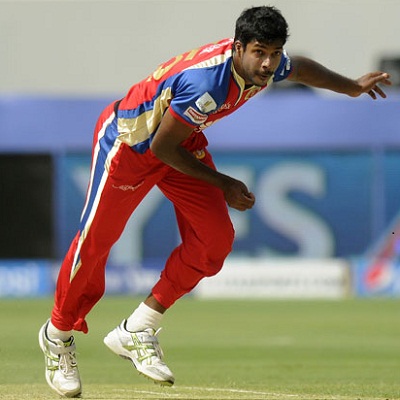
Fast and Furious: Varun Aaron has shone for RCB
But Indian pace bowling has been a story here of its own. Pace is a commodity erstwhile unknown in Indian bowling circles. Indian fast bowling has always been more about swing at medium pace than ferocious speed. This isn't the land of the Joel Garners and Andy Roberts; it's the home of Venkatesh Prasad and Zaheer Khan. But Varun Aaron is sending history for a toss. Everyone always knew Aaron was amongst the fastest Indians ever, but Indian pace bowlers, unlike the Australians and South Africans, often trade accuracy for speed. That was often part of the critique against Aaron as well. Not this year though. In 7 games so far, Varun Aaron has bagged 12 wickets at 16 runs a piece. He hasn't been all that expensive either, conceding a relatively moderate 7 runs per over. All that done consistently at 150 kph - a truly un-Indian return.

Aaron isn't alone. At the top of the wicket-takers list (at the time of this writing) sits the usually classy Bhuvneshwar Kumar with 15 scalps in 8 games (and a ridiculous economy rate of 5.50). Bhuvneshwar has generally been the saving grace of whichever team he plays for. When Chris Gayle destroyed Pune last season in his 175-run knock, Bhuvneshwar was the only Pune Warrior to walk off the field with his head held high. That confidence has helped him again this year, taking the new ball alongside Dale Steyn and making up for the lack of runs from the Sunrisers' illustrious top order.

Second to Bhuvi on the same list is Mohit Sharma - CSK's find from last year. Mohit Sharma has gone for nearly 8 runs per over, but that's only because MS Dhoni has had the confidence to throw him at the batsmen towards the end of an innings. The fact that Mohit has gone for less runs while picking up more wickets than his more experienced compatriot Ben Hilfenhaus speaks volumes of the man's growing stature in the game.

But perhaps the real find of the season here is a certain Punjabi called Sandeep Sharma. When KXIP walked out at the end of the auction, everyone saw their team as the 'batting unit of the season' with Mitchell Johnson to boot. The batting has fired (and how!), but Johnson has often taken the boot from opposition batsmen so far. Sandeep Sharma, by contrast, has picked up 13 wickets in just 6 games - and Chris Gayle and Virat Kohli twice at that. Sandeep isn't express fast either, but he's got nippy swing - perhaps the more Indian characteristic to have.

India tour England in July this year. The last time India went to England, they came back blanked. A lot has happened since (including another whitewash in Australia and more trouble in New Zealand) but perhaps the one constant in Indian cricket chats is the nagging problem of poor pace bowling. India are dominant at home where their batsmen chase down anything the opposition throws at them on tracks that are better flattened than the national highways. But when overseas, the test gets sterner. Of course, performances in the maverick format of T20 cricket can never be a guarantee for success at the highest level in the longest form of the game. But rarely has Indian pace bowling been at the receiving end of accolades for boasting talent. India now seems to have that strength in the reserve - with the pace of Umesh Yadav and Varun Aaron, the control and bounce of Mohammed Shami, the swing of Bhuvneshwar Kumar and the freshness of Sandeep and Mohit Sharma.

Team India's greatest trouble all along has been an unwillingness to penalize consistently poor performances from established players. Think of Ishant Sharma who, despite the odd great spell in Test match cricket, has done little to merit favors over the young men oozing talent below him. It's alright throwing the long rope to a player. But each time you do that, a potentially great player under him is losing out. Team India needs to manage its human resources better.

Friday, 4 April 2014

Australia's Tryst with Failure

When was the last time an Australian cricket team got sent off in the group stages of a World Cup tournament? When was the last time an Australian cricket team considered a win against Bangladesh their consolation prize? Twenty20 cricket does strange things to long-standing reputations, as George Bailey's men recently found out. With 3 losses in 4 games, the Baggy Greens are gone even before the semis started.

Perhaps it was Mitchell Johnson's absence that made the Australians so insipid on the field. After all, it was the 'Enforcer' who played the largest part in their Ashes whitewash not too long ago. But when you look more closely, you can't even compare that Ashes campaign with the WT20. Australia, like a lot of others, play different players in different formats. The side that came to Bangladesh a couple of weeks ago came without, not just Johnson, but also Clarke, Harris and Lyon. Indeed, Australia have been rather sceptical about the adaptability of their own players lately.

It's not hard for an Australian side to find inspiration. Few sides in world cricket have the kind of legacy they have. For over a decade, they dominated world cricket across formats, conditions and continents. A number of those who represented the country over that period in time went down as all-time legends, filling up history books and cricketing folktales. What was so different about them that made them so efficient?

The Invincibles: No Aussie team for a while will emulate them
It's in fact a couple of significant factors:

#1) Unparalleled talent: The Aussie side of the 2000s was made of men who set benchmarks in their respective fields. When one thinks of becoming a world-class wicketkeeper today, he takes inspiration from Adam Gilchrist. When one thinks of batting heroes, he invariably considers Ricky Ponting after Sachin Tendulkar. When one learns the art of pace bowling, he strives to achieve the standards of Glenn McGrath. When one takes up spin bowling, he looks up to Shane Warne. Put all those people in a single team. That's the one Ponting was fortunate enough to lead.

#2) Well-defined playing roles: Very rarely did you find the Australians mix and match their playing squad in the 2000s. The team sheet was largely known even before the tour began. That's because every man in that squad knew exactly what was required of him, and all that he ever did was play that role - and play it to perfection. Contrast that with what the Aussies do today. The Australian batting order goes through more shuffling with each passing game than a deck of cards in the casino. To the player, it's like a change of profession everyday.

#3) Hunt in pairs: One of the most striking features I noticed in the Aussie side of old is how they played in pairs. When you think of that Australian side, you almost never think of one single player without associating another man as his sidekick of sorts. Adam Gilchrist and Matthew Hayden, Ricky Ponting and Damien Martyn, Glenn McGrath and Brett Lee (or Shane Warne at times), Michael Hussey and Michael Clarke. One man often played in tandem with the other, their roles perfectly complementing each other. It's a trait few sides in modern cricket have mastered.

Granted, it's almost impossible for any future generation of cricketers to do what the Australia of the 2000s did. Seldom does there come a time when all your best talent as a nation is fitted into a single generation. When all that is exhausted, you spend the next few years searching in the hay for replacements that are hard to find. And in the process, you feel unsettled, confused and anxious. Poor old Bailey must only be moaning the words of Caius Cassius now - "Rome, thou hast lost the breed of noble bloods!"

Tuesday, 18 February 2014

The Mysteries of Triumph

What is "bad form"? Perhaps the finest description of the phrase came from the inimitably subtle Ian Chappell - "When things go wrong, they go wrong horribly, and seemingly forever." But then, it seems, even the reverse of that statement is just as true. 

Take two contrasting stories now - in the three years since his side lifted the World Cup (fittingly at home), Mahendra Singh Dhoni's Indian side have only pulled off one solitary Test win on foreign soil. That came at good old Kingston against the bumbling West Indies. That West Indies tour was followed up by a long transit in England. While India landed in the UK as the invincible world number one, they left having surrendered the Crown to their old colonial rulers. The England tour was soon followed by one to Australia, a few Tests at home, another tour to South Africa and now, New Zealand. In each of those countries - save at home - India were inostensibly blanked, and how.

Watching the Heavens Fall: Dhoni must reconjure belief
The second story is that of a certain Queenslander called Mitchell Johnson. In the space of mere months, Mitchell Johnson has gone from being the laughing stock of the galaxy (think of what the Barmy Army did to him during his last Ashes tour to England) to the next big thing in fast bowling circles since Jeffrey Thomson. For weeks, he tortured a hapless English side in different corners of Australia. The war was so bad for the Poms that their casualties list contained grander stars than the residual side it left behind - Jonathan Trott (who turned his back early), Graeme Swann, Kevin Pietersen and nearly Captain Cook himself. One might have been excused for thinking Johnson's carnage would be over once the Ashes was done. But the tornado has only just reached South Africa and Ryan McLaren is already nursing a wounded head. This man seems like he can do no wrong. And he's destroying careers around the world too.

Johnson, they say, has rediscovered himself after having gone through a 'shock therapy' with the great Dennis Lillee. I don't know about the 'shock', but there certainly seems to have been a lot of 'therapy'. Lillee put him through some grind, in trying to iron out his technical flaws - from his wrist position, to his leap and even his fox-like canter to the crease. But was it simply the technical training that did Johnson so much good, or was it more the confidence he gained out of getting the final thumbs-up from an all-time legend?

Sport is played in the mind, they say. And if one were to go by how the Indian captain has been leading his troops on foreign soil, confidence seems the only important 'technical' ingredient a professional player would ever need. Going by his words at press conferences and post-match interviews, MS Dhoni seems to have lost that faith in his players while overseas. With each passing game, all that Dhoni has been saying is "we have been improving" - almost like a class teacher patting the back of his under-par student who is striving hard. Thus, when MS Dhoni walks in for the coin toss in Durban, Auckland or London, he isn't thinking about winning. He's thinking about making sure he doesn't lose. And in trying so hard not to lose, Dhoni has forgotten how to win. Gone are the days when the Indian skipper said, "we're here to enjoy the game and give it our best" (as he did say over the course of his maiden World T20 win in 2007). It's no more about enjoying the game for the world's most stressed out and grey-haired sportsman. Leading India is now about overseeing an underconfident bunch of kids "improve" under his weary and exasperated eyes. Only so do you find India lose a game that has all but been won, time and again, in different time zones. From Brendon McCullum's other-worldly 302 in Wellington to Faf du Plessis' marathon innings in Johannesburg, India has been winning the wrong half of the game, and failing to close it out at the end. The misery seems unending.

So what does it take to win a game? Bowling the opposition out for 105 isn't sufficient anymore. The key is belief. Does belief come before victory? If MS Dhoni could ensure that it did while in South Africa seven years ago, I'm pretty certain he still can. The skipper must now take a bolder call.

Tuesday, 31 December 2013

Passing of an era

As 2013 comes to a close, what strikes the cricket lover most is how this year will always be remembered as the one which marked the end of an era and the beginning of another. With Jacques Kallis calling it quits a few days back, a log of nearly 43000 Test runs stopped counting, thanks to Sachin Tendulkar and Ricky Ponting who retired before him. That is in addition to Rahul Dravid and Andrew Strauss who stepped down last year, and Michael Hussey (who has quite a few Test runs himself, mind you), Tillakaratne Dilshan and Graeme Swann, all of whom quit Test cricket this year. (Jonathan Trott hasn't really retired, but he's quite on the edge, they say.) And with the Ashes far from over, half the England team are writing their wills too.

Colossus: Kallis marks the end of a great era of batsmen
All these retirements make me feel old. When was the last time we saw so many cricketers - legends and below - retire together in the same year? There's little doubt that cricket, through the 1990s and beyond the turn of the millennium, saw many a great legend make and break records. When folks like Tendulkar and Kallis were on, records used to fall almost every game. In fact, save for Allan Border, every single batsman in the top 10 run-getters in Test cricket history played beyond the year 2000. Whether that was because teams began playing more Test cricket in recent times or because batsmanship has evolved to attain greater glory, it's hard to tell. But there's little doubt that the likes of Tendulkar, Kallis, Lara, Ponting and Dravid each revolutionized the game in their own little ways. Now if you want to feel a little older than you already do, considering that the New Year is only a few hours away, hear this - none of the top 5 run-scorers in Test history play any longer. And Shiv Chanderpaul is the only man in the top 8 who still plays - even he, clearly, at the twilight of his long and interesting career.

But all this is not to tell a sob story to the world of cricket. To be sure, all those legends of yore have made way to likely legends of tomorrow. Men like Virat Kohli, Alastair Cook (hoping he survives to live a post-Ashes life), Joe Root and Cheteshwar Pujara are looking good to take the game forward, breaking newer barriers and perhaps even surpassing the grand heights that their predecessors had scaled. With batsmanship seemingly getting better with each passing day and T20 cricket adding a new dimension to how younger kids play, the top 5 batsmen we know today might be sitting a little lower tomorrow. There seems a definite sense of inspiration in the present crop of batsmen, taken from the men of old - Pujara from Dravid, Root from Boycott, Cook from Gooch, perhaps everyone from Tendulkar. So there seems a good possibility that the records we know today might well be broken tomorrow - including even Sachin Tendulkar's. After all, one would recall that back in the 1990s, Sunil Gavaskar and Allan Border seemed humanly impossible to surpass!

But what the cricketing world is likely to miss is someone who can score over 13000 Test runs while taking nearly 300 wickets with the ball - something that Jacques Henry Kallis actually managed to do. As Shaun Pollock mentioned during the recent Test match while on air, "You can find very good batsmen and you can find very good bowlers, but rarely can you find both of those in one man." Indeed, Jacques Kallis will be missed now more than anyone else in the game and the jury's out on whether modern day cricket can ever throw up such an extraordinary talent again. In fact, when you talk of Kallis, you're talking of not one legend, but two. And if you count his fielding skills in the slip cordon, make that three. But for all that he's worth, one often gets the feeling that Kallis, partly by his own good conduct as well as the team he was a part of, was downplayed as a great man all through his career. Would Kallis have been hailed as greater than Tendulkar if he were in the Indian team? One wonders.

With Kallis' Test career coming to an end, an era in international cricket has drawn to a close. Through 2012-2013, the world bid farewell to some enormous names and one wonders how many more are left to leave. But this is not all about nostalgia; there's a great deal of excitement in the new batch of cricketers coming through too!

Monday, 23 December 2013

Adding T20 spice to the Test curry

What an extraordinary few days these have been for Test cricket! Just while it seemed like Australia would succumb to the once-upon-a-time seemingly more balanced Englishmen, the Ashes have been swept away in a hurry and the Roos are now looking at a whitewash. England meanwhile have suffered many a high profile casualty in the ongoing Ashes war. If Jonathan Trott left for home on a temporary hiatus from competitive cricket, Graeme Swann has gone one step further in saying he'll never ever play the game again. That's two of England's finest gone, and the tour is only 60% done.

Few thousand miles away in the same Hemisphere meanwhile, the underdogs (funny when you consider ICC ranks them No. 2 in the world) nearly conquered the Proteas in their own savannas. Buoyed by the return of wily old Zaheer, the Indian Test team did what the world champion ODI team couldn't do - last a whole game against South Africa without being defeated.

Whoever once thought Test cricket obsolete surely is rolling in the mud right now. Never before have draws added so much of excitement to the game. And never before have draws been as desirable to the spectator as they have been of late. In fact, T20 didn't endanger Test match cricket. If anything, it only enhanced it. Is it a strange coincidence then that the number of Test matches ending with a result has only increased since the advent of T20?

Flying Kiwi: Williamson's stunning catch off Chanderpaul
While the classic connoisseur might squirm at the very mention of Twenty20, what he doesn't realize is that the little baby of world cricket has only made better that which gave birth to it. The new age batsman, unlike his monotonous Test-playing forefather, is not just brash and daring but also far more capable of adapting to situations. Only so would you find that Rahul Dravid's heir apparent Cheteshwar Pujara is able to strike boundaries when he so wills it, even as he grinds it out like his role model did for hours on end on the Test pitch. And just so do you witness AB de Villiers summon enough confidence to play the scoop shot in pure whites when he senses the need to win, even while he's amply capable of blocking and leaving, session after session.

But it's not just the batsmen. Mitchell Johnson's killer instincts might remind the old cricket-loving gentleman of his own contemporary - Jeff 'Thommo' Thompson. But Johnson isn't Thompson. He's a different breed - far more superior, agile, athletic and lethal. He knows how to take the batsman's head off, just as well as he knows how to crush his toes - a modern day skill born out of T20 needs and one that Stuart Broad experienced first hand from his Aussie rival at Perth.

And then the fielders; Ajinkya Rahane did twice in two days what his middle-aged forefathers found hard to do even once a season - fall into the earth, stop a speeding ball and take the stumps out with a full-blooded hurl at them. And in New Zealand, almost at the same time, Kane Williamson got rid of Shiv Chanderpaul by grasping a catch you'd have to see to believe. Indeed, the modern day tattoed-arm fielder - thanks to the furious pace of T20 cricket - is light years ahead on athleticism than the old times.

But above all, where T20 has really impacted Test cricket is in the way teams now think. The realms of possibility in the mind of the captain has widened incredibly today. What seemed impossible once upon a time is more readily chased down today. Two of the biggest fourth innings chases in Test cricket were scripted in the last 3 years and South Africa nearly added the topmost cherry last night. Indeed, the modern day captain is less afraid of losing than he was before - simply because he is far more confident of winning from a certain situation than he was previously. Players have become more versatile and, therefore better able and more willing to win games than before. And as a result of it all, the spectator is getting to see some riveting cricket for all that it's worth.

When T20 was invented, one hardly expected it to have an impact on the way Test cricket is played. As T20 became more commercial, there were alarms raised over the life expectancy of Test cricket. But what T20 has done instead is to spice up the Test curry and serve it with a delectable aroma. Cricket has never been better.

Sunday, 1 December 2013

Why Sachin deserves his Bharat Ratna

Just hours after the legend retired, Dr Singh's government presented him with that Indian award of awards - the Bharat Ratna. It seemed long overdue to many. But surprisingly, there were more than just a handful of dissidents, some rather politically influential. While a few claimed that it was an 'election campaign' publicity gimmick, others felt the government had jumped the gun.

Regardless of what dissidents think, I think there are ample reasons to assert why Sachin deserved his Bharat Ratna. Granted, he didn't rule the country, remove poverty, fight wars or save lives. But that isn't exactly what the Bharat Ratna is all about. Contrary to public thought, the Bharat Ratna isn't just meant for the 'messiahs' of the Indian people. It is in many ways borrowed from the Mughal concept of the 'Navratna' - the Emperor's nine court jewels that symbolized his reign and empire. Therefore, the Bharat Ratna is meant to felicitate those who symbolize the idea of India in some way or the other.

Motherland First: Sachin has been the new India's flagbearer
If one accepts that idea, it shouldn't be too hard to see why Sachin Tendulkar deserved the jewel. For 24 years, Indian cricket - indeed Indian sport - has been synonymous with Sachin Tendulkar. So much so that Mark 'Tubby' Taylor once remarked after losing to India that his Aussie side "lost to one man." In similar ways in fact, if one were to extend the argument, Tendulkar has been synonymous with world cricket itself. If cricket to the colonial world meant Sir Donald Bradman, cricket to the contemporary age means Sachin Tendulkar. There are countless individuals in different parts of the world - even where cricket has never gone - who adore Tendulkar without even knowing his trade. As one of my friends in the Middle East put it after his teary farewell, "I don't know cricket but I do know Sachin Tendulkar." Hard to think of another man who transcended his profession by such a distance!

But that isn't the only reason why Tendulkar deserves his Bharat Ratna. Consider India in 1989. A young democracy that was reeling under a lack of direction, searching for a path to its 'Tryst with Destiny'. Its economy was caged and soon nearly capitulated. Its finance minister had to pledge gold at the World Bank to keep his country alive. But perhaps in more relevant terms, its cricket team - its most followed sports outfit - was struggling too, for breath. Six years after a World Cup win, many were writing it off as a one-time wonder. That was in Tendulkar's early days.

But fast forward 24 years later. India is the world's third largest economy. Its consumerist middle class is making the world sit up and listen. It is world cricket's biggest superpower and nations jostle for its good offices. It owns one of world sport's most popular and powerful domestic leagues and millions (both people and dollars) are flowing into the country.

In the midst of it all, Tendulkar has been the one constant. His resilient career of 24 years has symbolized a new and buoyant India - one that has and will fight many odds and get better in the face of adversity. Tendulkar has been a brand ambassador for this new and buoyant India, defining and advertising its growing and widely acclaimed soft power. His cool and soft nature perfectly matches the world's view of India - a soft, peace-loving and tolerant force for good in the world.

India's soft power, they say today, is comparable to that of the rising superpower that Kennedy's America was in the 1960s. Several individuals are a part of it. Sachin Tendulkar one of the most notable ones - a true Bharat Ratna.

Thursday, 14 November 2013

The Next Brian Lara?

Even as Sachin Tendulkar plays his 200th and final Test match in his backyard in Mumbai, people everywhere are paying tributes to his marvelous career, asking almost rhetorically if there will ever again come a man who can strike out record books like he did. But for all of Tendulkar's superhuman feats on the cricket pitch, there is one particular record he hasn't broken (yet) - the highest Test score. Tendulkar has never scored a triple hundred in 24 years. The highest he has ever made in international cricket is an unbeaten 248 against Australia in Sydney nine years ago, in what was an innings of great resilience. But the highest score in Test cricket, of course, is well over that with fellow legend Brian Lara logging no less than 400 against England in Antigua.

So an interesting question was posed to me by my friend as we reminisced Tendulkar's 24-year-career. Will Lara's 400 ever be surpassed? Perhaps if Tendulkar couldn't do it, surely no one else can?

Spacewalk: The surreal scorecard
A key stat to note in both Tendulkar's 248 and Lara's 400 is that both those knocks were unbeaten. So if time and circumstance had allowed them to go on, God knows how far they would have reached! But that precisely is the point, isn't it? If one must score a triple hundred, or indeed a quadruple hundred in Test cricket, he needs to go at the rate of knots, before time annuls the game. That makes sense when you consider that the only four people to have thus far scored two triple hundreds in Test cricket are Sir Don Bradman, Brian Lara, Virender Sehwag and Chris Gayle - each one a devastating name of his generation, capable of sending shivers down the spines of the most rugged pacers.

That isn't to say that Tendulkar couldn't have joined them. After all, he did become the first man ever to have scored a double hundred in the 50-over game! So is strike rate the lone problem to breaking barriers in a Test innings? Not at all. The trouble with scoring big in Test match cricket is that you need to not just score at a rapid pace in order to keep time for your bowlers to gain a result out of the game, but also make sure you do it before you run out of partners at the other end. In other words, you need to make the most of every ball you face for hours and sessions on end - something that requires tremendous agility, fitness, concentration and mental toughness. So Tendulkar couldn't do it. Can anyone still?

The one man most people would have backed to break Lara's 400 is Virender Sehwag. Sehwag is perfect for the job. He is devastating on his day; he makes the most of every ball he faces; he scores runs so quickly that it doesn't matter how long he bats; and above all, he is the kind of guy who will try hitting you for six even on 299*. That ticks almost all the boxes you need. But Sehwag seems to be past his prime and is currently on exile from the Indian team, playing in little towns for little teams. One can't tell how long it will take him to be back in Team India if ever, but even if he does, the age old question of 'is he too old' will continue to persist.

So if one were to count out Virender Sehwag for the moment, the hunt for the next Brian Lara can be streamlined to the hunt for the next Virender Sehwag. That should be much simpler surely, considering that modern day batsmen have become far bolder after the advent of T20 cricket? Maybe not. But even as he struck a string of hundreds in the early part of his career in the Baggy Greens, David Warner seemed like the deal. But soon enough, he ran into trouble and only retains a ceremonial position now at the top of Australia's batting line-up.

Many then would be tempted to go for Virat Kohli. The man, after all, is all of only 24 years and in many ways seems 'the modern day version of Sachin Tendulkar' (but when did Tendulkar become ancient anyway?) Kohli seems a likely candidate. He is gritty alright, and scored a fine hundred in Adelaide on India's abysmal tour there nearly two years ago. He has also shown the ability to score hundreds off fifty balls and consistently win T20s when they long seemed lost. But can Kohli do all of that and be consistent with the rapid scoring for all of 400 runs, coming in at four in the Indian Test team? Perhaps. But also perhaps not. At any rate, it seems unlikely that Virat Kohli's batting role in the Indian Test team will afford him the luxury to do it at any given time. It also remains to be seen if Kohli can bring his ODI batting prowess to the Test arena without losing the strike rate too much.

That brings me to my favorite candidate now - Shikhar Dhawan. Shikhar Dhawan, following his reinvention after an embarrassing start in 2010 against Australia, has become all but the next Virender Sehwag. Winning a Test debut earlier this year, Dhawan avenged his earlier failures by smashing a breathtaking 187 against the same opponent. He then went to England for the Champions Trophy and ravaged every part of the British Isles for a fortnight, before eventually returning with the cup. Indeed, he is devastating. He is gritty. He makes the most of every ball he faces. He doesn't mind whacking sixes in the 90s (or 190s or 290s or 390s, although he hasn't got there yet.) He has the right attitude to batting. He has the right team around him. And if you must add more, he too is from Delhi.

Of course, scouting someone who can be the next Brian Lara isn't just difficult; it is impossible. Lara didn't just hit triple hundreds; he hit bloody big ones and did it twice. Surpassing his 400 is obviously going to be the stuff of legend. And someone is going to have to be living the most divine day of his life to make it happen. Something still tells me that it's as unlikely as can be.

Thursday, 31 October 2013

The Elusive Art of Bowling

India and Australia are currently locked in an enthralling bilateral series in the subcontinent. Of the six games played, both sides have won two each with the visiting cyclone taking the other two. As you'd expect in India, batsmen have been ruling the roost. But not like before. Excluding the half game at Ranchi and the washout at Cuttack, both sides have scored over 300 each time they've batted, save for India's collapse for 232 in the very first game. That, of course, included the fairytale 360-run chase by India in Jaipur.

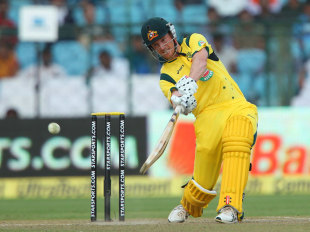
Heave-ho: Bailey has been a prime slogger so far
Although their bowling hasn't fared much better, Australia have been playing a settled eleven in all the games thus far. India, on the other hand, have been playing Russian roulette with their tailenders. Ishant Sharma has till now been the most notable victim with Ravichandran Ashwin tempting fate with every passing game. But the slam-bang in this series so far has even rattled Captain Cool MS Dhoni who quietly confided after the last game that he no longer knows what constitutes 'good bowling'. Indeed, the very art of bowling has started to prove increasingly elusive at least in the subcontinent. The new rules of ODI cricket (Google them if you want to) has left MS Dhoni fuming at times and exasperated at other times as captain on the field. All is well when his batsmen know how much to get. But as George Bailey has found out twice already now, it's anybody's guess how much is enough to restrict the willow-wielders wreaking havoc these days.

Of course, beyond a doubt, watching batsmen on a rampage is highly entertaining. For years now, the sole objective of cricket's lawmakers has been to increase the number of fours and sixes. They have done this by bringing in the boundary ropes a mile from the crowd, making grass become nearly frictionless (I'm a science student and I find this particularly intriguing), replacing the batsmen's earlier sticks with thick wooden clubs, tightening the popping crease on the hapless bowler and asking the captain to leave the farther outfield virtually deserted. In result, with each passing game and each new debutant, world cricket's erudite rulers have allowed past batting records look silly. Worse still, bowling has been reduced to mere formality. Gone are the days of bowling skill in the one-day game when the strength of the pacer and the vile of the spinner could win you games. If the game that Andy Roberts and Malcolm Marshall played back in the 1970s was called cricket, this isn't cricket.

The sad part about the one-sided batsman's game we now watch is that bowling isn't the only casualty; slam-bang cricket also takes the sting out of fielding and captaincy skills. The fact that your bowlers aren't expected to win you games anymore means that your fielders are less motivated to turn in outfield brilliance. Captains too have become helpless on the field with all those restrictions putting a cap on their thinking and imagination. It's alright these days to concede 300+ bowling first simply because you know you can chase it.

All this isn't to say that the modern day batsman is an untalented slogger. Indeed, some of Virat Kohli's silken drives and Rohit Sharma's late cuts invoke memories of old, when batting was far more tested and runs scarcer. But both the spectator and the lawmaker need to understand that cricket isn't simply a game of batting - no more than baseball is a game of slugging. But unlike the baseball pitcher who has a natural advantage with the pace he generates and the weight of the ball he chucks, the modern day bowler has little in the game to safeguard his rights. It's certainly harder to get the slogging batsman bowled today than it is to go past the baseball slugger for three strikes. Some say that cricket has evolved. I don't think that should mean a streamlining of skill. The rest, of course, is for the crowd to decide.

Thursday, 10 October 2013

The Master Graduates

It's the biggest news of them all - Sachin Ramesh Tendulkar will soon be history (of course, he's also made enough of it). The next few days will see tributes flowing in from across the cricket world, even before Tendulkar plays what will be his final Test at the Wankhede against the West Indies. Personally, I had wished that Tendulkar retired after the magical World Cup win in 2011. It was a World Cup after all. And it was his home ground too. And he was being carried around the field by a third generation of cricketers whom he's shared the dressing room with. What could be more romantic than a goodbye at that point? But Tendulkar had only scored 99 international hundreds by that day (yes, I said 'only'). And fairytales don't happen in sport. Remember Sir Bradman's last innings?

A Final Wave: Tendulkar now leaves cricket
When Sachin Tendulkar finally bids adieu to the cricketing world at the Wankhede, he would have played a total of 200 Test matches in a career spanning 24 years. That's literally almost the size of two high-quality professional careers on its own and Tendulkar's cricketing odyssey is older than my own little story on Earth. After Sachin Tendulkar retired from ODI cricket late last year, Harsha Bhogle made a rather interesting observation - "What percentage of Indians is below the age of 23? That's the number of Indians who've never known an Indian team without Tendulkar!" Indeed, I've never seen an Indian team without Tendulkar hanging around it somewhere. When injured, the world hollered to see him back. When dropped (who dared do that?), Mumbai shut down. When 'rested', the captain had a tough time answering pressers.

But the greatest tribute I've yet read to a sporting legend came in TIME's May 21 edition last year. I found it rather striking to see a cover story on a cricketer in an American magazine, going to the extent of calling him the 'world's best athlete'. Surely, they loved baseball more? But as I read the article, I got increasingly fixated by it, until I came across an interesting comparison somewhere in the middle. Here's what the author said, in essence - To understand Sachin Tendulkar, imagine Michael Jordan for a moment. Imagine Jordan played for the United States of America and not the Chicago Bulls. Then imagine that the population of the United States is 1.2 billion and consider that at least a billion out of that number take basketball to be a matter of life and death. And imagine Team USA toured the world all year long, tirelessly. And now imagine that Michael Jordan is the single greatest American sportsman in history and has been doing all of this for a period of 23 years. Now you have Sachin Tendulkar.

The author then further went on to say - In most sports, you would find that one 'great man' who transcends them all, but you would also find someone breathing down his neck, waiting to break his records. Not Sachin Tendulkar. The man second best to him is Australia's Ricky Ponting, who has 71 international hundreds to Tendulkar's 100.

In conclusion, the author says, Sachin Tendulkar is the 'world's best athlete'.

The numbers apart, there are many reasons to cherish Tendulkar's legacy. Consider the fact that he entered the Indian team at the age of 16 and was promptly sent off on a tour to Pakistan - a place where India used to send more soldiers than cricketers at any given point in time. And he didn't simply explode onto the scene - it took Tendulkar no less than 5 years and 78 ODI innings in order to get his first limited overs hundred. But unlike a number of other perhaps equally talented child prodigies who burst onto the scene - Hasan Raza made his Pakistan debut at the age of 14 and Tatenda Taibu for Zimbabwe at 18 - Tendulkar did not simply fade away. He kept himself grounded and gazed dreamily at the skies in pursuit of his legacy; and built it across three generations of Team India.

Today, as the world listened to Sachin Tendulkar announce his retirement, one is inclined to recall how Indian cricket has evolved during Tendulkar's career - from the shy, under-confident outfit of 1989 to the young and rather brash World Champion unit of 2013, the story of Indian cricket is tightly woven around Tendulkar's own. I know there are those out there who'd have loved to see him go on forever. But finally, the Master graduates.

Sunday, 6 October 2013

Era of Legends

Rahul Dravid and Sachin Tendulkar are currently facing off each other (unfortunately, yes, they're on opposite sides) in what will be their last limited overs game in competitive cricket. That's quite a big moment for Indian cricket. The Dravid-Tendulkar combine has scored a total of 29315 runs in the Indian Blue. I'm not going to try counting the List A domestic one-day runs here. The figure is astronomical and rather unnecessary to quote. And there is no need of stats and figures to measure the legacy of the Dravid-Tendulkar era. Both of them took Indian sport to new heights, not just on but also off the field. The dignified nature of the duo will be sorely missed in modern-day cricket - a place where young kids face off mercilessly, each one writing his own code of conduct.

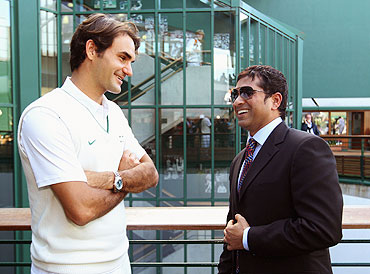
Hall of History: Roger Federer with Sachin Tendulkar
When one thinks of modern sport and the legends that adorn it, a number of names spring to mind - Sachin Tendulkar, of course, but also inevitably, Roger Federer, Tiger Woods (against his ex-wife's wishes), Lance Armstrong (until his bubble broke), Michael Schumacher (before he ruined the aura of invincibility around him), and perhaps even Usain Bolt (the self-confessed 'legend'). Discussing this landmark Champions League game, one of my friends asked me - "Do you think anyone will ever come near Federer or Tendulkar in our lifetime?"

That's a toughie. I'm a big fan of the former - someone I consider as the greatest sportsman I've seen - and also a dreamy admirer of the latter. To me, Tendulkar and Federer (indeed, even Dravid) are not merely names attached to a string of numbers. Undoubtedly, the scoreboard is all important in the world of sport. But then there are those who, over a period of time, transcend it. There are those who become independent of numerals for their survival in the Hall of History. Tendulkar and Federer sit at the top of that list. They are those who define their respective sports, rather than the other way round.

But leaving the romantic rhetoric aside, my friend's question still is a very interesting - and certainly complex - one. Consider the current crop of players. Many say that Virat Kohli and his fiery brand of cricket has already taken him to places Tendulkar had never been to at his age. Yes indeed, when you add the fact that there is far more cricket being played today, at least by India, than there was during Tendulkar's heydays, Kohli has a chance of not just surpassing Tendulkar's record, but maybe even setting a new one in some far distant statistical galaxy.

But that's not as easy as it sounds. Tendulkar became Tendulkar, not just thanks to his run-scoring ability, but also his longevity. 24 years is an awful lot of time in any profession these days, let alone sport. In a tumbling global economy, one now sees 40-year-old software engineers get laid off. But not Tendulkar. Indeed, the man is well past his prime, and probably has been for a couple of years now - maybe more. But even the harshest Tendulkar critic would agree that the maestro's best days stretched right from 1989 to at least 2004. That in itself is 15 years - the average span of some of the greatest players in modern history. Kohli's challenge then won't just be to score runs; it'll be to keep them coming for a sustained period of time. That would take great fitness, agility, mental aptitude and strength of character, including a cool head. There are reasons to be sceptical about the young man yet.

Come to Federer now. Roger Federer entered professional tennis in his teens as a hot-headed young man. It took over a year of mental conditioning thereafter for Federer to reinvent himself. When he returned, he took court to become one of the greatest sportsmen in history, now sitting on a record 17 Grand Slams. But the Federer stats chase is a little more complex than the Tendulkar stats chase. Unlike Tendulkar, Federer has a reinvigorated Rafael Nadal rushing up the ladder with 13 Slams against his name. Will Nadal catch up? He could, and certainly has a greater chance than Virat Kohli has in Tendulkar's case today, but again, it's a question of how long he can last. Nadal's knee injuries are the stuff of tennis folklore and despite some dramatic bounce-backs, few can guarantee his body will last the long haul. His style of play is particularly damaging on the knee and every time Nadal tries to change the way he plays, he simply doesn't look as scary. But there are other factors too: Federer spent a total of 237 weeks as world number one between February 2004 and August 2008. That was a period when the Swiss master went largely unchallenged, save again, for Rafa Nadal. Nadal doesn't have the luxury of dominating world tennis the way Federer did, not just because of his knee, but also because he lives in the era of Djokovic and Murray. It seems to me that for the next 3-4 years at the least, Nadal, Djokovic and Murray will share Grand Slam honors with each other, with one of them or someone else winning the fourth Slam of the year. Even that should be enough for Nadal to beat Federer's Grand Slam record, unless he loses his stronghold at Roland Garros. But again, Nadal's greatest enemy when it comes to longevity is not Djokovic or Murray, but his own knee.

In many ways, as amusing as it may seem, Nadal's knee will decide the settings of tennis history for the next few years to come. Kohli's attitude on the cricket pitch may too do the same.

Monday, 23 September 2013

CLT20, Chimps & Champs

Here's yet another T20 league on the international circuit! The Champions League T20 is into its fifth year now and somehow, when coupled in the same year as the Indian Premier League, one would feel it seems rather annoyingly redundant. But there's something different about the CLT20 this year (or there at least was) - we had a Pakistan team; although the Faisalabad Wolves, overawed by the rare opportunity to visit their 'superpower neighbor', caved in during the course of the qualifiers and ensured their non-participation in the main draw. There were wild dogs howling everywhere even before the Wolves landed in India with radical Hindutva agents saying Pakistan should cease to be recognized as a nation following their antics on the border and the Indian government officials conveniently sleeping over the players' visas until a day or two before their arrival. In the end, all that turned out to be a non-event with the Wolves, save for the unflappable Misbah, succumbing to all and sundry in the three games they played.

That then leaves us in the main draw with 4 Indian teams (well, for all technical purposes, you can count Mitchell Johnson and Dwayne Bravo to be Indian too for now), 2 South African and Australian teams each, and 1 team each from the Caribbean and New Zealand. The Sri Lankans and Pakistanis lost their only representatives in the qualifying stages and will now have to shift loyalties to their 'superpower neighbor' if they want to partake any further in the tournament.

Showstopper: Dhoni's mohawk has been the sole talking point
Crowds thus far at the CLT20 have been abysmally thin and that brings to my point on why the CLT20 still is a redundant phenomenon. The CLT20 was thought to have been conceptualized back in 2009 in order to have a fair competition between the best clubs of each league in the world. That was what I thought at least 4 years ago. But now when I come to think of it, when 40% of the main draw is Indian and the semifinals by all means might be 100% Indian, the CLT20 is not much different from the IPL T20 after all. Barring the Indian domination, the Bangladeshis didn't have a representative even in the qualifying stages and for unofficially known reasons, the English have been forbidden from taking part in a game they themselves invented. This clearly isn't a league of champions; it's a league of Indians garnished with a handful of other teams.

The question now is whether the CLT20 really needs to take place at all. In its current format, certainly not. Although T20 cricket is rather entertaining and watching Kieron Pollard tonk sixes anywhere is mesmerizing, there's only so much of it that fans can really relate to passionately enough. Anything overdone is unessential and more so when it's done in so redundant and pointless a fashion as the CLT20 currently is. The BCCI needs to rethink this tournament before it throws away the charm of the game. But maybe for the greater good, the BCCI shouldn't have veto powers in the matter at all.

Sunday, 14 July 2013

Umpiring the Ump

What a great game of Test cricket at Nottingham! If there ever was a need for an advertisement of Test match cricket, here was one. Notably, we seem to be getting quite a few of these of late. In fact, Test match cricket has become so interesting in the modern day that the case for getting rid of it now seems increasingly absurd! What is equally absurd though is the case for extending the failed DRS or Decision Review System. England won't be complaining about the DRS at all, considering that it has won them the first match this Ashes. It's almost intriguing too that the tides of the DRS - a system so staunchly supported by viewers and experts in England - always seem to favor the Poms!

Frankly speaking, the DRS is a failed mechanism. Although novel when introduced, the system has been disappointing in adding flavor to the game. Let's face it - the DRS has taken the zing out of this particular Test match for both sides. The umpires have been allowed far less sleep after its inception and captains now spend as much time training their players on umpiring as they do on batting, bowling or fielding! There are technical issues with the DRS as well, I hear, but I have enough complaints against it without having to even touch on those.

Crossing his heart: Umpire overturning a decision
Firstly, as hard as it is for the system's supporters to admit this, players are not exactly great umpires and they certainly aren't great umpires when they're playing for their country and are fighting for sporting glory. They don't have to be either. Even if they were great umpires, there is enough stress on them to perform their playing duties without having to watch the lines, predict leg-befores or sense faint edges. Why all this fuss? If the umpire can't do his job all so well, how can the players be expected to do it? After all, when the ball is being bowled, the umpire has nothing else to do but watch closely and make decisions. He's paid for it and he's expected to be good at it. If part of his job is being given to the player, you might as well start allowing umpires play for their teams on the field as well!

My second grievance with the DRS is the fact that the umpire's authority on the field is essentially being challenged by it. An umpire is a match official. He is above and beyond the players and therefore, it is his duty to ensure that the game is played fair and square. As much as we universally agree that an umpire is a human being and is hence entitled to make his fair share of mistakes, no umpire likes to know when his decision is wrong. No umpire likes to overturn a decision. It is no coincidence then that when an umpire overturns a decision early in the match, he suddenly starts looking so ordinary for the rest of the game. No, it messes with the morale of the umpire. He does not feel authoritative anymore and when an umpire does not feel like an authority, he almost loses the ability to stand above and beyond the game of cricket he officiates in, thereby becoming unable to ensure that the game is played fair and square. After all, that is his primary duty, without which, in the age of technology, there is no need for him to stand with a hat on his head all day.

My third grievance is quite clear cut. When an umpire has a bad day and gives an absolute howler of a decision at a crucial juncture in a match (like Aleem Dar did with Stuart Broad) and when the team at the receiving end has run out of reviews to challenge him (like Australia did in the same episode), the DRS effectively fails. The DRS, I hope, wasn't formulated in order to check the umpiring skills of players and captains and penalize them for default on that front. It was, again I hope, formulated in order to arrive at the right decision. In the above instance, the right decision certainly wasn't arrived at. At the end of the game, that particular instance proved to be quite decisive and Australia, therefore, in a way lost this match due to their poor umpiring skills. So how then did the DRS prove to be a success?

My case is not to call for a return to the previous status quo. What world cricket needs is to stop reviewing the umpire and allow the umpire review for himself. It must become more of a convention - perhaps even part of the training of umpires - to use technology by on-field discretion when you're in doubt. Also, when an on-field umpire makes a call which violates all common sense and is clearly obvious to the man assisted by technology (which is the third umpire), the latter must make an intervention and ask the on-field umpire to correct his call. In this way, the umpires are not made to lose their authority and nor are they challenged, and eventually, the correct call is made every single time. The players are also relieved of their umpiring duty and can now play the game without a fuss.

When the DRS was introduced, many people called comparisons with tennis and invoked the great success of the review system in that game. Unfortunately, cricket is not tennis. Cricket involves far more complex variables and there is nothing really clear cut about it. So it's time to let the umpires do their job without wreaking any further havoc.

Friday, 5 July 2013

Wimbledon 2013 - Still anybody's game

I'm a bit late on my blog post on Wimbledon this year - one of my most favorite sporting tournaments. What makes Wimbledon so special is, of course, the court. Not many lawn tennis tours in the modern day are really played on lawn. The reason is pretty obvious - lawn courts are terribly difficult to maintain in pristine condition. This year's Wimbledon just proved how difficult maintaining lawn courts can be. In what later became an unfortunate incident, the All England Lawn Tennis Club's main groundsman retired last year. Perhaps not so coincidentally, everyone playing at SW19 this year have been slipping and sliding on some lush grass. To be frank, as a viewer of Wimbledon this year, I've felt at times as though I was watching an ice skating show, not so much the showpiece event of world tennis. From Maria Sharapova to Victoria Azarenka, tennis stars have been falling flat on the ground. Perhaps the nastiest fall of them all was suffered by Juan Martin Del Potro during his quarterfinal game against Spaniard David Ferrer. Luckily for Del Potro, his 6'6" height means that the court is only three steps wide, so he later decided that he would win the game without having to sprint after the ball at all.

The Fancied Quartet: All back home
Slippery or not, lawn generally is hailed as the surface that separates the legends from the lads. To win on grass, one needs a sharp and accurate serve, some great court sense and a rather cool head. Blind slapping won't work here. Perhaps that explains why the genius of Roger Federer held sway over The Championships for so long, winning the title seven times! That's what makes lawn tennis so exciting - a moment of callousness can cost you a game, a set, maybe even a match. And so, even though I'd blogged last year about Wimbledon being anybody's game, one year on, nothing much has changed about that theme. In fact, things have only gotten eerier! Rafael Nadal, flying to London after winning Roland Garros for the eighth time, was put on a flight back to Mallorca very early by an unheard Steve Darcis. Maria Sharapova, the powerhouse of female tennis, slipped, skated and slid out in the first week as well. Victoria Azarenka barely put a foot on court before packing her bags due to injury. Defeat also greeted Caroline Wozniacki early in the tourney with the Dane blaming the grass for her undoing. Serena Williams - a player so dominant that Andy Murray thought of challenging her to play him - lasted long enough to dominate the little known players in the first week but bowed out in the quarters against a reinvented Sabine Lisicki. But perhaps the greatest upset of them all - Roger Federer, holder of every known record in Wimbledon and world tennis history, crashing out in the second round to Sergiy Stakhovsky. Stakhovsky may well make it to many a quiz question in the near future if Federer decides to retire anytime soon.

What really made the difference this year? Was it the grass? Was it a dying old generation? Or was it simply the growing prowess of unknown names in world tennis? The answer to me seemed fearlessness. While many big guns seemed hounded by their past glory and pressed by intimidating expectations, the little unheralded kids of world tennis played a freewheeling brand of tennis largely unseen in past years and highly suited for lawn courts. Sabine Lisicki's defeat of Serena Williams was particularly revealing on that front. With the big American expected to steamroll the unfancied German with a barrage of aces and whizzing winners, Sabine let loose her passions on court and played particularly aggressive tennis with little regard for the scoreboard.

Perhaps the grass was rather slippery. But then again, it was the same old grass for Sabine Lisicki and Del Potro as it was for Rafael Nadal or Serena Williams. Grass often tends to favor the brave. For that reason, the hallowed lawns of Wimbledon would probably always be for anybody's taking.