Monday, 23 December 2013

Adding T20 spice to the Test curry

What an extraordinary few days these have been for Test cricket! Just while it seemed like Australia would succumb to the once-upon-a-time seemingly more balanced Englishmen, the Ashes have been swept away in a hurry and the Roos are now looking at a whitewash. England meanwhile have suffered many a high profile casualty in the ongoing Ashes war. If Jonathan Trott left for home on a temporary hiatus from competitive cricket, Graeme Swann has gone one step further in saying he'll never ever play the game again. That's two of England's finest gone, and the tour is only 60% done.

Few thousand miles away in the same Hemisphere meanwhile, the underdogs (funny when you consider ICC ranks them No. 2 in the world) nearly conquered the Proteas in their own savannas. Buoyed by the return of wily old Zaheer, the Indian Test team did what the world champion ODI team couldn't do - last a whole game against South Africa without being defeated.

Whoever once thought Test cricket obsolete surely is rolling in the mud right now. Never before have draws added so much of excitement to the game. And never before have draws been as desirable to the spectator as they have been of late. In fact, T20 didn't endanger Test match cricket. If anything, it only enhanced it. Is it a strange coincidence then that the number of Test matches ending with a result has only increased since the advent of T20?

Flying Kiwi: Williamson's stunning catch off Chanderpaul
While the classic connoisseur might squirm at the very mention of Twenty20, what he doesn't realize is that the little baby of world cricket has only made better that which gave birth to it. The new age batsman, unlike his monotonous Test-playing forefather, is not just brash and daring but also far more capable of adapting to situations. Only so would you find that Rahul Dravid's heir apparent Cheteshwar Pujara is able to strike boundaries when he so wills it, even as he grinds it out like his role model did for hours on end on the Test pitch. And just so do you witness AB de Villiers summon enough confidence to play the scoop shot in pure whites when he senses the need to win, even while he's amply capable of blocking and leaving, session after session.

But it's not just the batsmen. Mitchell Johnson's killer instincts might remind the old cricket-loving gentleman of his own contemporary - Jeff 'Thommo' Thompson. But Johnson isn't Thompson. He's a different breed - far more superior, agile, athletic and lethal. He knows how to take the batsman's head off, just as well as he knows how to crush his toes - a modern day skill born out of T20 needs and one that Stuart Broad experienced first hand from his Aussie rival at Perth.

And then the fielders; Ajinkya Rahane did twice in two days what his middle-aged forefathers found hard to do even once a season - fall into the earth, stop a speeding ball and take the stumps out with a full-blooded hurl at them. And in New Zealand, almost at the same time, Kane Williamson got rid of Shiv Chanderpaul by grasping a catch you'd have to see to believe. Indeed, the modern day tattoed-arm fielder - thanks to the furious pace of T20 cricket - is light years ahead on athleticism than the old times.

But above all, where T20 has really impacted Test cricket is in the way teams now think. The realms of possibility in the mind of the captain has widened incredibly today. What seemed impossible once upon a time is more readily chased down today. Two of the biggest fourth innings chases in Test cricket were scripted in the last 3 years and South Africa nearly added the topmost cherry last night. Indeed, the modern day captain is less afraid of losing than he was before - simply because he is far more confident of winning from a certain situation than he was previously. Players have become more versatile and, therefore better able and more willing to win games than before. And as a result of it all, the spectator is getting to see some riveting cricket for all that it's worth.

When T20 was invented, one hardly expected it to have an impact on the way Test cricket is played. As T20 became more commercial, there were alarms raised over the life expectancy of Test cricket. But what T20 has done instead is to spice up the Test curry and serve it with a delectable aroma. Cricket has never been better.

Sunday, 1 December 2013

Why Sachin deserves his Bharat Ratna

Just hours after the legend retired, Dr Singh's government presented him with that Indian award of awards - the Bharat Ratna. It seemed long overdue to many. But surprisingly, there were more than just a handful of dissidents, some rather politically influential. While a few claimed that it was an 'election campaign' publicity gimmick, others felt the government had jumped the gun.

Regardless of what dissidents think, I think there are ample reasons to assert why Sachin deserved his Bharat Ratna. Granted, he didn't rule the country, remove poverty, fight wars or save lives. But that isn't exactly what the Bharat Ratna is all about. Contrary to public thought, the Bharat Ratna isn't just meant for the 'messiahs' of the Indian people. It is in many ways borrowed from the Mughal concept of the 'Navratna' - the Emperor's nine court jewels that symbolized his reign and empire. Therefore, the Bharat Ratna is meant to felicitate those who symbolize the idea of India in some way or the other.

Motherland First: Sachin has been the new India's flagbearer
If one accepts that idea, it shouldn't be too hard to see why Sachin Tendulkar deserved the jewel. For 24 years, Indian cricket - indeed Indian sport - has been synonymous with Sachin Tendulkar. So much so that Mark 'Tubby' Taylor once remarked after losing to India that his Aussie side "lost to one man." In similar ways in fact, if one were to extend the argument, Tendulkar has been synonymous with world cricket itself. If cricket to the colonial world meant Sir Donald Bradman, cricket to the contemporary age means Sachin Tendulkar. There are countless individuals in different parts of the world - even where cricket has never gone - who adore Tendulkar without even knowing his trade. As one of my friends in the Middle East put it after his teary farewell, "I don't know cricket but I do know Sachin Tendulkar." Hard to think of another man who transcended his profession by such a distance!

But that isn't the only reason why Tendulkar deserves his Bharat Ratna. Consider India in 1989. A young democracy that was reeling under a lack of direction, searching for a path to its 'Tryst with Destiny'. Its economy was caged and soon nearly capitulated. Its finance minister had to pledge gold at the World Bank to keep his country alive. But perhaps in more relevant terms, its cricket team - its most followed sports outfit - was struggling too, for breath. Six years after a World Cup win, many were writing it off as a one-time wonder. That was in Tendulkar's early days.

But fast forward 24 years later. India is the world's third largest economy. Its consumerist middle class is making the world sit up and listen. It is world cricket's biggest superpower and nations jostle for its good offices. It owns one of world sport's most popular and powerful domestic leagues and millions (both people and dollars) are flowing into the country.

In the midst of it all, Tendulkar has been the one constant. His resilient career of 24 years has symbolized a new and buoyant India - one that has and will fight many odds and get better in the face of adversity. Tendulkar has been a brand ambassador for this new and buoyant India, defining and advertising its growing and widely acclaimed soft power. His cool and soft nature perfectly matches the world's view of India - a soft, peace-loving and tolerant force for good in the world.

India's soft power, they say today, is comparable to that of the rising superpower that Kennedy's America was in the 1960s. Several individuals are a part of it. Sachin Tendulkar one of the most notable ones - a true Bharat Ratna.

Thursday, 14 November 2013

The Next Brian Lara?

Even as Sachin Tendulkar plays his 200th and final Test match in his backyard in Mumbai, people everywhere are paying tributes to his marvelous career, asking almost rhetorically if there will ever again come a man who can strike out record books like he did. But for all of Tendulkar's superhuman feats on the cricket pitch, there is one particular record he hasn't broken (yet) - the highest Test score. Tendulkar has never scored a triple hundred in 24 years. The highest he has ever made in international cricket is an unbeaten 248 against Australia in Sydney nine years ago, in what was an innings of great resilience. But the highest score in Test cricket, of course, is well over that with fellow legend Brian Lara logging no less than 400 against England in Antigua.

So an interesting question was posed to me by my friend as we reminisced Tendulkar's 24-year-career. Will Lara's 400 ever be surpassed? Perhaps if Tendulkar couldn't do it, surely no one else can?

Spacewalk: The surreal scorecard
A key stat to note in both Tendulkar's 248 and Lara's 400 is that both those knocks were unbeaten. So if time and circumstance had allowed them to go on, God knows how far they would have reached! But that precisely is the point, isn't it? If one must score a triple hundred, or indeed a quadruple hundred in Test cricket, he needs to go at the rate of knots, before time annuls the game. That makes sense when you consider that the only four people to have thus far scored two triple hundreds in Test cricket are Sir Don Bradman, Brian Lara, Virender Sehwag and Chris Gayle - each one a devastating name of his generation, capable of sending shivers down the spines of the most rugged pacers.

That isn't to say that Tendulkar couldn't have joined them. After all, he did become the first man ever to have scored a double hundred in the 50-over game! So is strike rate the lone problem to breaking barriers in a Test innings? Not at all. The trouble with scoring big in Test match cricket is that you need to not just score at a rapid pace in order to keep time for your bowlers to gain a result out of the game, but also make sure you do it before you run out of partners at the other end. In other words, you need to make the most of every ball you face for hours and sessions on end - something that requires tremendous agility, fitness, concentration and mental toughness. So Tendulkar couldn't do it. Can anyone still?

The one man most people would have backed to break Lara's 400 is Virender Sehwag. Sehwag is perfect for the job. He is devastating on his day; he makes the most of every ball he faces; he scores runs so quickly that it doesn't matter how long he bats; and above all, he is the kind of guy who will try hitting you for six even on 299*. That ticks almost all the boxes you need. But Sehwag seems to be past his prime and is currently on exile from the Indian team, playing in little towns for little teams. One can't tell how long it will take him to be back in Team India if ever, but even if he does, the age old question of 'is he too old' will continue to persist.

So if one were to count out Virender Sehwag for the moment, the hunt for the next Brian Lara can be streamlined to the hunt for the next Virender Sehwag. That should be much simpler surely, considering that modern day batsmen have become far bolder after the advent of T20 cricket? Maybe not. But even as he struck a string of hundreds in the early part of his career in the Baggy Greens, David Warner seemed like the deal. But soon enough, he ran into trouble and only retains a ceremonial position now at the top of Australia's batting line-up.

Many then would be tempted to go for Virat Kohli. The man, after all, is all of only 24 years and in many ways seems 'the modern day version of Sachin Tendulkar' (but when did Tendulkar become ancient anyway?) Kohli seems a likely candidate. He is gritty alright, and scored a fine hundred in Adelaide on India's abysmal tour there nearly two years ago. He has also shown the ability to score hundreds off fifty balls and consistently win T20s when they long seemed lost. But can Kohli do all of that and be consistent with the rapid scoring for all of 400 runs, coming in at four in the Indian Test team? Perhaps. But also perhaps not. At any rate, it seems unlikely that Virat Kohli's batting role in the Indian Test team will afford him the luxury to do it at any given time. It also remains to be seen if Kohli can bring his ODI batting prowess to the Test arena without losing the strike rate too much.

That brings me to my favorite candidate now - Shikhar Dhawan. Shikhar Dhawan, following his reinvention after an embarrassing start in 2010 against Australia, has become all but the next Virender Sehwag. Winning a Test debut earlier this year, Dhawan avenged his earlier failures by smashing a breathtaking 187 against the same opponent. He then went to England for the Champions Trophy and ravaged every part of the British Isles for a fortnight, before eventually returning with the cup. Indeed, he is devastating. He is gritty. He makes the most of every ball he faces. He doesn't mind whacking sixes in the 90s (or 190s or 290s or 390s, although he hasn't got there yet.) He has the right attitude to batting. He has the right team around him. And if you must add more, he too is from Delhi.

Of course, scouting someone who can be the next Brian Lara isn't just difficult; it is impossible. Lara didn't just hit triple hundreds; he hit bloody big ones and did it twice. Surpassing his 400 is obviously going to be the stuff of legend. And someone is going to have to be living the most divine day of his life to make it happen. Something still tells me that it's as unlikely as can be.

Thursday, 31 October 2013

The Elusive Art of Bowling

India and Australia are currently locked in an enthralling bilateral series in the subcontinent. Of the six games played, both sides have won two each with the visiting cyclone taking the other two. As you'd expect in India, batsmen have been ruling the roost. But not like before. Excluding the half game at Ranchi and the washout at Cuttack, both sides have scored over 300 each time they've batted, save for India's collapse for 232 in the very first game. That, of course, included the fairytale 360-run chase by India in Jaipur.

Heave-ho: Bailey has been a prime slogger so far
Although their bowling hasn't fared much better, Australia have been playing a settled eleven in all the games thus far. India, on the other hand, have been playing Russian roulette with their tailenders. Ishant Sharma has till now been the most notable victim with Ravichandran Ashwin tempting fate with every passing game. But the slam-bang in this series so far has even rattled Captain Cool MS Dhoni who quietly confided after the last game that he no longer knows what constitutes 'good bowling'. Indeed, the very art of bowling has started to prove increasingly elusive at least in the subcontinent. The new rules of ODI cricket (Google them if you want to) has left MS Dhoni fuming at times and exasperated at other times as captain on the field. All is well when his batsmen know how much to get. But as George Bailey has found out twice already now, it's anybody's guess how much is enough to restrict the willow-wielders wreaking havoc these days.

Of course, beyond a doubt, watching batsmen on a rampage is highly entertaining. For years now, the sole objective of cricket's lawmakers has been to increase the number of fours and sixes. They have done this by bringing in the boundary ropes a mile from the crowd, making grass become nearly frictionless (I'm a science student and I find this particularly intriguing), replacing the batsmen's earlier sticks with thick wooden clubs, tightening the popping crease on the hapless bowler and asking the captain to leave the farther outfield virtually deserted. In result, with each passing game and each new debutant, world cricket's erudite rulers have allowed past batting records look silly. Worse still, bowling has been reduced to mere formality. Gone are the days of bowling skill in the one-day game when the strength of the pacer and the vile of the spinner could win you games. If the game that Andy Roberts and Malcolm Marshall played back in the 1970s was called cricket, this isn't cricket.

The sad part about the one-sided batsman's game we now watch is that bowling isn't the only casualty; slam-bang cricket also takes the sting out of fielding and captaincy skills. The fact that your bowlers aren't expected to win you games anymore means that your fielders are less motivated to turn in outfield brilliance. Captains too have become helpless on the field with all those restrictions putting a cap on their thinking and imagination. It's alright these days to concede 300+ bowling first simply because you know you can chase it.

All this isn't to say that the modern day batsman is an untalented slogger. Indeed, some of Virat Kohli's silken drives and Rohit Sharma's late cuts invoke memories of old, when batting was far more tested and runs scarcer. But both the spectator and the lawmaker need to understand that cricket isn't simply a game of batting - no more than baseball is a game of slugging. But unlike the baseball pitcher who has a natural advantage with the pace he generates and the weight of the ball he chucks, the modern day bowler has little in the game to safeguard his rights. It's certainly harder to get the slogging batsman bowled today than it is to go past the baseball slugger for three strikes. Some say that cricket has evolved. I don't think that should mean a streamlining of skill. The rest, of course, is for the crowd to decide.

Thursday, 10 October 2013

The Master Graduates

It's the biggest news of them all - Sachin Ramesh Tendulkar will soon be history (of course, he's also made enough of it). The next few days will see tributes flowing in from across the cricket world, even before Tendulkar plays what will be his final Test at the Wankhede against the West Indies. Personally, I had wished that Tendulkar retired after the magical World Cup win in 2011. It was a World Cup after all. And it was his home ground too. And he was being carried around the field by a third generation of cricketers whom he's shared the dressing room with. What could be more romantic than a goodbye at that point? But Tendulkar had only scored 99 international hundreds by that day (yes, I said 'only'). And fairytales don't happen in sport. Remember Sir Bradman's last innings?

A Final Wave: Tendulkar now leaves cricket
When Sachin Tendulkar finally bids adieu to the cricketing world at the Wankhede, he would have played a total of 200 Test matches in a career spanning 24 years. That's literally almost the size of two high-quality professional careers on its own and Tendulkar's cricketing odyssey is older than my own little story on Earth. After Sachin Tendulkar retired from ODI cricket late last year, Harsha Bhogle made a rather interesting observation - "What percentage of Indians is below the age of 23? That's the number of Indians who've never known an Indian team without Tendulkar!" Indeed, I've never seen an Indian team without Tendulkar hanging around it somewhere. When injured, the world hollered to see him back. When dropped (who dared do that?), Mumbai shut down. When 'rested', the captain had a tough time answering pressers.

But the greatest tribute I've yet read to a sporting legend came in TIME's May 21 edition last year. I found it rather striking to see a cover story on a cricketer in an American magazine, going to the extent of calling him the 'world's best athlete'. Surely, they loved baseball more? But as I read the article, I got increasingly fixated by it, until I came across an interesting comparison somewhere in the middle. Here's what the author said, in essence - To understand Sachin Tendulkar, imagine Michael Jordan for a moment. Imagine Jordan played for the United States of America and not the Chicago Bulls. Then imagine that the population of the United States is 1.2 billion and consider that at least a billion out of that number take basketball to be a matter of life and death. And imagine Team USA toured the world all year long, tirelessly. And now imagine that Michael Jordan is the single greatest American sportsman in history and has been doing all of this for a period of 23 years. Now you have Sachin Tendulkar.

The author then further went on to say - In most sports, you would find that one 'great man' who transcends them all, but you would also find someone breathing down his neck, waiting to break his records. Not Sachin Tendulkar. The man second best to him is Australia's Ricky Ponting, who has 71 international hundreds to Tendulkar's 100.

In conclusion, the author says, Sachin Tendulkar is the 'world's best athlete'.

The numbers apart, there are many reasons to cherish Tendulkar's legacy. Consider the fact that he entered the Indian team at the age of 16 and was promptly sent off on a tour to Pakistan - a place where India used to send more soldiers than cricketers at any given point in time. And he didn't simply explode onto the scene - it took Tendulkar no less than 5 years and 78 ODI innings in order to get his first limited overs hundred. But unlike a number of other perhaps equally talented child prodigies who burst onto the scene - Hasan Raza made his Pakistan debut at the age of 14 and Tatenda Taibu for Zimbabwe at 18 - Tendulkar did not simply fade away. He kept himself grounded and gazed dreamily at the skies in pursuit of his legacy; and built it across three generations of Team India.

Today, as the world listened to Sachin Tendulkar announce his retirement, one is inclined to recall how Indian cricket has evolved during Tendulkar's career - from the shy, under-confident outfit of 1989 to the young and rather brash World Champion unit of 2013, the story of Indian cricket is tightly woven around Tendulkar's own. I know there are those out there who'd have loved to see him go on forever. But finally, the Master graduates.

Sunday, 6 October 2013

Era of Legends

Rahul Dravid and Sachin Tendulkar are currently facing off each other (unfortunately, yes, they're on opposite sides) in what will be their last limited overs game in competitive cricket. That's quite a big moment for Indian cricket. The Dravid-Tendulkar combine has scored a total of 29315 runs in the Indian Blue. I'm not going to try counting the List A domestic one-day runs here. The figure is astronomical and rather unnecessary to quote. And there is no need of stats and figures to measure the legacy of the Dravid-Tendulkar era. Both of them took Indian sport to new heights, not just on but also off the field. The dignified nature of the duo will be sorely missed in modern-day cricket - a place where young kids face off mercilessly, each one writing his own code of conduct.

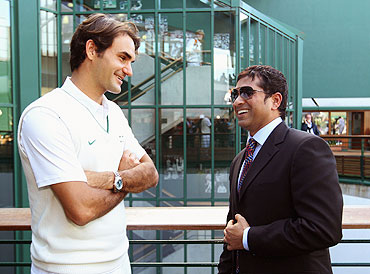
Hall of History: Roger Federer with Sachin Tendulkar
When one thinks of modern sport and the legends that adorn it, a number of names spring to mind - Sachin Tendulkar, of course, but also inevitably, Roger Federer, Tiger Woods (against his ex-wife's wishes), Lance Armstrong (until his bubble broke), Michael Schumacher (before he ruined the aura of invincibility around him), and perhaps even Usain Bolt (the self-confessed 'legend'). Discussing this landmark Champions League game, one of my friends asked me - "Do you think anyone will ever come near Federer or Tendulkar in our lifetime?"

That's a toughie. I'm a big fan of the former - someone I consider as the greatest sportsman I've seen - and also a dreamy admirer of the latter. To me, Tendulkar and Federer (indeed, even Dravid) are not merely names attached to a string of numbers. Undoubtedly, the scoreboard is all important in the world of sport. But then there are those who, over a period of time, transcend it. There are those who become independent of numerals for their survival in the Hall of History. Tendulkar and Federer sit at the top of that list. They are those who define their respective sports, rather than the other way round.

But leaving the romantic rhetoric aside, my friend's question still is a very interesting - and certainly complex - one. Consider the current crop of players. Many say that Virat Kohli and his fiery brand of cricket has already taken him to places Tendulkar had never been to at his age. Yes indeed, when you add the fact that there is far more cricket being played today, at least by India, than there was during Tendulkar's heydays, Kohli has a chance of not just surpassing Tendulkar's record, but maybe even setting a new one in some far distant statistical galaxy.

But that's not as easy as it sounds. Tendulkar became Tendulkar, not just thanks to his run-scoring ability, but also his longevity. 24 years is an awful lot of time in any profession these days, let alone sport. In a tumbling global economy, one now sees 40-year-old software engineers get laid off. But not Tendulkar. Indeed, the man is well past his prime, and probably has been for a couple of years now - maybe more. But even the harshest Tendulkar critic would agree that the maestro's best days stretched right from 1989 to at least 2004. That in itself is 15 years - the average span of some of the greatest players in modern history. Kohli's challenge then won't just be to score runs; it'll be to keep them coming for a sustained period of time. That would take great fitness, agility, mental aptitude and strength of character, including a cool head. There are reasons to be sceptical about the young man yet.

Come to Federer now. Roger Federer entered professional tennis in his teens as a hot-headed young man. It took over a year of mental conditioning thereafter for Federer to reinvent himself. When he returned, he took court to become one of the greatest sportsmen in history, now sitting on a record 17 Grand Slams. But the Federer stats chase is a little more complex than the Tendulkar stats chase. Unlike Tendulkar, Federer has a reinvigorated Rafael Nadal rushing up the ladder with 13 Slams against his name. Will Nadal catch up? He could, and certainly has a greater chance than Virat Kohli has in Tendulkar's case today, but again, it's a question of how long he can last. Nadal's knee injuries are the stuff of tennis folklore and despite some dramatic bounce-backs, few can guarantee his body will last the long haul. His style of play is particularly damaging on the knee and every time Nadal tries to change the way he plays, he simply doesn't look as scary. But there are other factors too: Federer spent a total of 237 weeks as world number one between February 2004 and August 2008. That was a period when the Swiss master went largely unchallenged, save again, for Rafa Nadal. Nadal doesn't have the luxury of dominating world tennis the way Federer did, not just because of his knee, but also because he lives in the era of Djokovic and Murray. It seems to me that for the next 3-4 years at the least, Nadal, Djokovic and Murray will share Grand Slam honors with each other, with one of them or someone else winning the fourth Slam of the year. Even that should be enough for Nadal to beat Federer's Grand Slam record, unless he loses his stronghold at Roland Garros. But again, Nadal's greatest enemy when it comes to longevity is not Djokovic or Murray, but his own knee.

In many ways, as amusing as it may seem, Nadal's knee will decide the settings of tennis history for the next few years to come. Kohli's attitude on the cricket pitch may too do the same.

Monday, 23 September 2013

CLT20, Chimps & Champs

Here's yet another T20 league on the international circuit! The Champions League T20 is into its fifth year now and somehow, when coupled in the same year as the Indian Premier League, one would feel it seems rather annoyingly redundant. But there's something different about the CLT20 this year (or there at least was) - we had a Pakistan team; although the Faisalabad Wolves, overawed by the rare opportunity to visit their 'superpower neighbor', caved in during the course of the qualifiers and ensured their non-participation in the main draw. There were wild dogs howling everywhere even before the Wolves landed in India with radical Hindutva agents saying Pakistan should cease to be recognized as a nation following their antics on the border and the Indian government officials conveniently sleeping over the players' visas until a day or two before their arrival. In the end, all that turned out to be a non-event with the Wolves, save for the unflappable Misbah, succumbing to all and sundry in the three games they played.

That then leaves us in the main draw with 4 Indian teams (well, for all technical purposes, you can count Mitchell Johnson and Dwayne Bravo to be Indian too for now), 2 South African and Australian teams each, and 1 team each from the Caribbean and New Zealand. The Sri Lankans and Pakistanis lost their only representatives in the qualifying stages and will now have to shift loyalties to their 'superpower neighbor' if they want to partake any further in the tournament.

Showstopper: Dhoni's mohawk has been the sole talking point
Crowds thus far at the CLT20 have been abysmally thin and that brings to my point on why the CLT20 still is a redundant phenomenon. The CLT20 was thought to have been conceptualized back in 2009 in order to have a fair competition between the best clubs of each league in the world. That was what I thought at least 4 years ago. But now when I come to think of it, when 40% of the main draw is Indian and the semifinals by all means might be 100% Indian, the CLT20 is not much different from the IPL T20 after all. Barring the Indian domination, the Bangladeshis didn't have a representative even in the qualifying stages and for unofficially known reasons, the English have been forbidden from taking part in a game they themselves invented. This clearly isn't a league of champions; it's a league of Indians garnished with a handful of other teams.

The question now is whether the CLT20 really needs to take place at all. In its current format, certainly not. Although T20 cricket is rather entertaining and watching Kieron Pollard tonk sixes anywhere is mesmerizing, there's only so much of it that fans can really relate to passionately enough. Anything overdone is unessential and more so when it's done in so redundant and pointless a fashion as the CLT20 currently is. The BCCI needs to rethink this tournament before it throws away the charm of the game. But maybe for the greater good, the BCCI shouldn't have veto powers in the matter at all.