Saturday, 19 July 2014

Tale of Two Captains

India's tour of England this summer is made rather fascinating by its timing. If you had to pick out two heavyweight cricket teams in the world today who are both struggling with recent history, you'd probably go with India and England. No other cricket team in the world, save perhaps Australia at times, has to contend with as much media scrutiny as these two, and it isn't just on the field; the standing of - and relationship between - the BCCI and the ECB is uncannily similar to what had been of Kennedy's America and Khruschev's Soviet Union in the 1960s. To put more blatantly, this is the Cold War of world cricket.

On the field, you find two teams in painful transition. India's legacy of relative overseas success under Sourav Ganguly has evaporated following the post-World Cup debacles in England and Australia (and later, in South Africa and New Zealand, where MS Dhoni's men failed to tally much in terms of results). The young boys of Indian cricket, to many, seem over-addicted to T20 cricket and incapable still of filling the big boots of Sachin Tendulkar, Rahul Dravid and VVS Laxman (to be fair to them, those are some king-sized boots).

Tactful Twosome: Cook has it harder than Dhoni
England too have had their share of ill fate recently. Their last Test win came in Chester-le-Street in August last year. Incidentally, that capped off a successful Ashes series which seemed to suggest that England were here to dominate - and for long. But as destiny would have it, only a few months later, all that ambition was washed away on the return tour to Australia - an odyssey that ended with the tourists losing not just all 5 games but also two of their premium batsmen and lone specialist spinner.

In many ways, even the two captains seem to have much in common. Much like MS Dhoni, Alastair Cook faces intense media interrogation back in England, with the mikes and cameras following him everywhere. And much like Dhoni, Cook proves to be ever reclusive in the spotlight, soft-spoken and diplomatic in press conferences and almost stoic in the face of journalistic aggression. Cook and Dhoni don't quite follow the old-school Australian principle of 'give 'em as good as you get', both preferring rather to stay away from the whole ordeal as far as possible. Expectedly then, all of the 'inter-personal battle' hype prior to the start of the series was created and sustained entirely by the media, with players from neither side choosing to add any venom to the contest (surprisingly, even James Anderson's reported punch at Ravindra Jadeja in the dressing rooms of Nottingham hasn't quite escalated to too much).

There are other striking similarities between both Dhoni and Cook. Both seem to enjoy captaining younger players more than the senior ones. Under Dhoni's watch, following the retirement of all the great legends, other stalwarts including Gambhir, Sehwag, Yuvraj and Zaheer have failed to find rehabilitation in the side, although the performances of their supposed replacements (Dhawan for Sehwag and Gambhir, Jadeja for Yuvraj, Ishant for Zaheer) have been far from encouraging. Cook, on his part, has drawn considerable flak for the mismanagement of Pietersen, Trott and Swann - the casualties of the Australia tour. And only to add, the seniors in his current squad, including Ian Bell, Matt Prior and himself, seem far removed from the enthusiasm of the young guns.

It's well possible that what seems like the mishandling of seniors stems from the fact that both Dhoni and Cook are leading sides under generational transition. And unlike the Australian public, the Indian and English followers are less willing to see a senior veteran get thrown out of the squad unceremoniously. But Cook has a larger problem - his own authority within the England team. With the captain's own performances turning ever more disastrous with each passing day, seniors within the England side (starting with Pietersen whilst he was there) are beginning to question the leadership credentials of Alastair Cook and whether he should be captain at all. Unfortunately, it's harder for Alastair Cook to convince his superiors and teammates that he is a deserving captain than it is for MS Dhoni. For one, Cook isn't a multiple World Cup winning captain. Second, his task is made much harder by the fact that he's an opening batsman. Opening batsmen are more susceptible to excessive scrutiny than middle-order batsmen, for the obvious reason that they are the most visible. If MS Dhoni is running through a miserable patch as a batsman, he can still hide behind the force of a fairly formidable and star-studded top-order, or even behind his own showings as a world-class wicketkeeper. Alastair Cook doesn't have that luxury.

It does seem like the England team are expecting a bit too much out of their captain. On the one hand, everyone expects him to lead a team undergoing a difficult phase of transition. On the other, they expect him to do it while his own authority is openly under question. If Cook doesn't find form soon and restore faith in those under and above him, England are headed for a tumultuous World Cup campaign Down Under next year. Perhaps the wiser option would be to identify and groom a more suitable leader before that tournament.

Sunday, 11 May 2014

India's Golden Era of Pace?

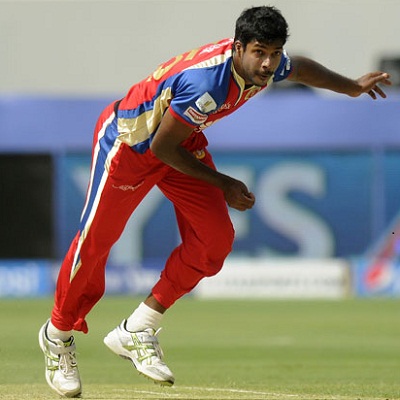
How often do you see Indian fast bowlers dominate headlines during a T20 tournament in the subcontinent? IPL-7 is breaking all those traditions. Put in a nutshell, this season has been all about overseas batsmen and Indian bowlers. Glenn Maxwell, David Miller, Dwayne Smith and JP Duminy have all dominated proceedings so far. But on the other side of the pitch are Varun Aaron, Sandeep Sharma and Bhuvneshwar Kumar - all giving them a tougher fight than expected. Young Yuzvendra Chahal has been a revelation so far, as has been Pravin Tambe (a man 20 years older than his RCB rival) who now even has a hat-trick to his credit at the evergreen age of 42.

Fast and Furious: Varun Aaron has shone for RCB
But Indian pace bowling has been a story here of its own. Pace is a commodity erstwhile unknown in Indian bowling circles. Indian fast bowling has always been more about swing at medium pace than ferocious speed. This isn't the land of the Joel Garners and Andy Roberts; it's the home of Venkatesh Prasad and Zaheer Khan. But Varun Aaron is sending history for a toss. Everyone always knew Aaron was amongst the fastest Indians ever, but Indian pace bowlers, unlike the Australians and South Africans, often trade accuracy for speed. That was often part of the critique against Aaron as well. Not this year though. In 7 games so far, Varun Aaron has bagged 12 wickets at 16 runs a piece. He hasn't been all that expensive either, conceding a relatively moderate 7 runs per over. All that done consistently at 150 kph - a truly un-Indian return.

Aaron isn't alone. At the top of the wicket-takers list (at the time of this writing) sits the usually classy Bhuvneshwar Kumar with 15 scalps in 8 games (and a ridiculous economy rate of 5.50). Bhuvneshwar has generally been the saving grace of whichever team he plays for. When Chris Gayle destroyed Pune last season in his 175-run knock, Bhuvneshwar was the only Pune Warrior to walk off the field with his head held high. That confidence has helped him again this year, taking the new ball alongside Dale Steyn and making up for the lack of runs from the Sunrisers' illustrious top order.

Second to Bhuvi on the same list is Mohit Sharma - CSK's find from last year. Mohit Sharma has gone for nearly 8 runs per over, but that's only because MS Dhoni has had the confidence to throw him at the batsmen towards the end of an innings. The fact that Mohit has gone for less runs while picking up more wickets than his more experienced compatriot Ben Hilfenhaus speaks volumes of the man's growing stature in the game.

But perhaps the real find of the season here is a certain Punjabi called Sandeep Sharma. When KXIP walked out at the end of the auction, everyone saw their team as the 'batting unit of the season' with Mitchell Johnson to boot. The batting has fired (and how!), but Johnson has often taken the boot from opposition batsmen so far. Sandeep Sharma, by contrast, has picked up 13 wickets in just 6 games - and Chris Gayle and Virat Kohli twice at that. Sandeep isn't express fast either, but he's got nippy swing - perhaps the more Indian characteristic to have.

India tour England in July this year. The last time India went to England, they came back blanked. A lot has happened since (including another whitewash in Australia and more trouble in New Zealand) but perhaps the one constant in Indian cricket chats is the nagging problem of poor pace bowling. India are dominant at home where their batsmen chase down anything the opposition throws at them on tracks that are better flattened than the national highways. But when overseas, the test gets sterner. Of course, performances in the maverick format of T20 cricket can never be a guarantee for success at the highest level in the longest form of the game. But rarely has Indian pace bowling been at the receiving end of accolades for boasting talent. India now seems to have that strength in the reserve - with the pace of Umesh Yadav and Varun Aaron, the control and bounce of Mohammed Shami, the swing of Bhuvneshwar Kumar and the freshness of Sandeep and Mohit Sharma.

Team India's greatest trouble all along has been an unwillingness to penalize consistently poor performances from established players. Think of Ishant Sharma who, despite the odd great spell in Test match cricket, has done little to merit favors over the young men oozing talent below him. It's alright throwing the long rope to a player. But each time you do that, a potentially great player under him is losing out. Team India needs to manage its human resources better.

Friday, 4 April 2014

Australia's Tryst with Failure

When was the last time an Australian cricket team got sent off in the group stages of a World Cup tournament? When was the last time an Australian cricket team considered a win against Bangladesh their consolation prize? Twenty20 cricket does strange things to long-standing reputations, as George Bailey's men recently found out. With 3 losses in 4 games, the Baggy Greens are gone even before the semis started.

Perhaps it was Mitchell Johnson's absence that made the Australians so insipid on the field. After all, it was the 'Enforcer' who played the largest part in their Ashes whitewash not too long ago. But when you look more closely, you can't even compare that Ashes campaign with the WT20. Australia, like a lot of others, play different players in different formats. The side that came to Bangladesh a couple of weeks ago came without, not just Johnson, but also Clarke, Harris and Lyon. Indeed, Australia have been rather sceptical about the adaptability of their own players lately.

It's not hard for an Australian side to find inspiration. Few sides in world cricket have the kind of legacy they have. For over a decade, they dominated world cricket across formats, conditions and continents. A number of those who represented the country over that period in time went down as all-time legends, filling up history books and cricketing folktales. What was so different about them that made them so efficient?

The Invincibles: No Aussie team for a while will emulate them
It's in fact a couple of significant factors:

#1) Unparalleled talent: The Aussie side of the 2000s was made of men who set benchmarks in their respective fields. When one thinks of becoming a world-class wicketkeeper today, he takes inspiration from Adam Gilchrist. When one thinks of batting heroes, he invariably considers Ricky Ponting after Sachin Tendulkar. When one learns the art of pace bowling, he strives to achieve the standards of Glenn McGrath. When one takes up spin bowling, he looks up to Shane Warne. Put all those people in a single team. That's the one Ponting was fortunate enough to lead.

#2) Well-defined playing roles: Very rarely did you find the Australians mix and match their playing squad in the 2000s. The team sheet was largely known even before the tour began. That's because every man in that squad knew exactly what was required of him, and all that he ever did was play that role - and play it to perfection. Contrast that with what the Aussies do today. The Australian batting order goes through more shuffling with each passing game than a deck of cards in the casino. To the player, it's like a change of profession everyday.

#3) Hunt in pairs: One of the most striking features I noticed in the Aussie side of old is how they played in pairs. When you think of that Australian side, you almost never think of one single player without associating another man as his sidekick of sorts. Adam Gilchrist and Matthew Hayden, Ricky Ponting and Damien Martyn, Glenn McGrath and Brett Lee (or Shane Warne at times), Michael Hussey and Michael Clarke. One man often played in tandem with the other, their roles perfectly complementing each other. It's a trait few sides in modern cricket have mastered.

Granted, it's almost impossible for any future generation of cricketers to do what the Australia of the 2000s did. Seldom does there come a time when all your best talent as a nation is fitted into a single generation. When all that is exhausted, you spend the next few years searching in the hay for replacements that are hard to find. And in the process, you feel unsettled, confused and anxious. Poor old Bailey must only be moaning the words of Caius Cassius now - "Rome, thou hast lost the breed of noble bloods!"

Tuesday, 18 February 2014

The Mysteries of Triumph

What is "bad form"? Perhaps the finest description of the phrase came from the inimitably subtle Ian Chappell - "When things go wrong, they go wrong horribly, and seemingly forever." But then, it seems, even the reverse of that statement is just as true. 

Take two contrasting stories now - in the three years since his side lifted the World Cup (fittingly at home), Mahendra Singh Dhoni's Indian side have only pulled off one solitary Test win on foreign soil. That came at good old Kingston against the bumbling West Indies. That West Indies tour was followed up by a long transit in England. While India landed in the UK as the invincible world number one, they left having surrendered the Crown to their old colonial rulers. The England tour was soon followed by one to Australia, a few Tests at home, another tour to South Africa and now, New Zealand. In each of those countries - save at home - India were inostensibly blanked, and how.

Watching the Heavens Fall: Dhoni must reconjure belief
The second story is that of a certain Queenslander called Mitchell Johnson. In the space of mere months, Mitchell Johnson has gone from being the laughing stock of the galaxy (think of what the Barmy Army did to him during his last Ashes tour to England) to the next big thing in fast bowling circles since Jeffrey Thomson. For weeks, he tortured a hapless English side in different corners of Australia. The war was so bad for the Poms that their casualties list contained grander stars than the residual side it left behind - Jonathan Trott (who turned his back early), Graeme Swann, Kevin Pietersen and nearly Captain Cook himself. One might have been excused for thinking Johnson's carnage would be over once the Ashes was done. But the tornado has only just reached South Africa and Ryan McLaren is already nursing a wounded head. This man seems like he can do no wrong. And he's destroying careers around the world too.

Johnson, they say, has rediscovered himself after having gone through a 'shock therapy' with the great Dennis Lillee. I don't know about the 'shock', but there certainly seems to have been a lot of 'therapy'. Lillee put him through some grind, in trying to iron out his technical flaws - from his wrist position, to his leap and even his fox-like canter to the crease. But was it simply the technical training that did Johnson so much good, or was it more the confidence he gained out of getting the final thumbs-up from an all-time legend?

Sport is played in the mind, they say. And if one were to go by how the Indian captain has been leading his troops on foreign soil, confidence seems the only important 'technical' ingredient a professional player would ever need. Going by his words at press conferences and post-match interviews, MS Dhoni seems to have lost that faith in his players while overseas. With each passing game, all that Dhoni has been saying is "we have been improving" - almost like a class teacher patting the back of his under-par student who is striving hard. Thus, when MS Dhoni walks in for the coin toss in Durban, Auckland or London, he isn't thinking about winning. He's thinking about making sure he doesn't lose. And in trying so hard not to lose, Dhoni has forgotten how to win. Gone are the days when the Indian skipper said, "we're here to enjoy the game and give it our best" (as he did say over the course of his maiden World T20 win in 2007). It's no more about enjoying the game for the world's most stressed out and grey-haired sportsman. Leading India is now about overseeing an underconfident bunch of kids "improve" under his weary and exasperated eyes. Only so do you find India lose a game that has all but been won, time and again, in different time zones. From Brendon McCullum's other-worldly 302 in Wellington to Faf du Plessis' marathon innings in Johannesburg, India has been winning the wrong half of the game, and failing to close it out at the end. The misery seems unending.

So what does it take to win a game? Bowling the opposition out for 105 isn't sufficient anymore. The key is belief. Does belief come before victory? If MS Dhoni could ensure that it did while in South Africa seven years ago, I'm pretty certain he still can. The skipper must now take a bolder call.

Tuesday, 31 December 2013

Passing of an era

As 2013 comes to a close, what strikes the cricket lover most is how this year will always be remembered as the one which marked the end of an era and the beginning of another. With Jacques Kallis calling it quits a few days back, a log of nearly 43000 Test runs stopped counting, thanks to Sachin Tendulkar and Ricky Ponting who retired before him. That is in addition to Rahul Dravid and Andrew Strauss who stepped down last year, and Michael Hussey (who has quite a few Test runs himself, mind you), Tillakaratne Dilshan and Graeme Swann, all of whom quit Test cricket this year. (Jonathan Trott hasn't really retired, but he's quite on the edge, they say.) And with the Ashes far from over, half the England team are writing their wills too.

Colossus: Kallis marks the end of a great era of batsmen
All these retirements make me feel old. When was the last time we saw so many cricketers - legends and below - retire together in the same year? There's little doubt that cricket, through the 1990s and beyond the turn of the millennium, saw many a great legend make and break records. When folks like Tendulkar and Kallis were on, records used to fall almost every game. In fact, save for Allan Border, every single batsman in the top 10 run-getters in Test cricket history played beyond the year 2000. Whether that was because teams began playing more Test cricket in recent times or because batsmanship has evolved to attain greater glory, it's hard to tell. But there's little doubt that the likes of Tendulkar, Kallis, Lara, Ponting and Dravid each revolutionized the game in their own little ways. Now if you want to feel a little older than you already do, considering that the New Year is only a few hours away, hear this - none of the top 5 run-scorers in Test history play any longer. And Shiv Chanderpaul is the only man in the top 8 who still plays - even he, clearly, at the twilight of his long and interesting career.

But all this is not to tell a sob story to the world of cricket. To be sure, all those legends of yore have made way to likely legends of tomorrow. Men like Virat Kohli, Alastair Cook (hoping he survives to live a post-Ashes life), Joe Root and Cheteshwar Pujara are looking good to take the game forward, breaking newer barriers and perhaps even surpassing the grand heights that their predecessors had scaled. With batsmanship seemingly getting better with each passing day and T20 cricket adding a new dimension to how younger kids play, the top 5 batsmen we know today might be sitting a little lower tomorrow. There seems a definite sense of inspiration in the present crop of batsmen, taken from the men of old - Pujara from Dravid, Root from Boycott, Cook from Gooch, perhaps everyone from Tendulkar. So there seems a good possibility that the records we know today might well be broken tomorrow - including even Sachin Tendulkar's. After all, one would recall that back in the 1990s, Sunil Gavaskar and Allan Border seemed humanly impossible to surpass!

But what the cricketing world is likely to miss is someone who can score over 13000 Test runs while taking nearly 300 wickets with the ball - something that Jacques Henry Kallis actually managed to do. As Shaun Pollock mentioned during the recent Test match while on air, "You can find very good batsmen and you can find very good bowlers, but rarely can you find both of those in one man." Indeed, Jacques Kallis will be missed now more than anyone else in the game and the jury's out on whether modern day cricket can ever throw up such an extraordinary talent again. In fact, when you talk of Kallis, you're talking of not one legend, but two. And if you count his fielding skills in the slip cordon, make that three. But for all that he's worth, one often gets the feeling that Kallis, partly by his own good conduct as well as the team he was a part of, was downplayed as a great man all through his career. Would Kallis have been hailed as greater than Tendulkar if he were in the Indian team? One wonders.

With Kallis' Test career coming to an end, an era in international cricket has drawn to a close. Through 2012-2013, the world bid farewell to some enormous names and one wonders how many more are left to leave. But this is not all about nostalgia; there's a great deal of excitement in the new batch of cricketers coming through too!

Monday, 23 December 2013

Adding T20 spice to the Test curry

What an extraordinary few days these have been for Test cricket! Just while it seemed like Australia would succumb to the once-upon-a-time seemingly more balanced Englishmen, the Ashes have been swept away in a hurry and the Roos are now looking at a whitewash. England meanwhile have suffered many a high profile casualty in the ongoing Ashes war. If Jonathan Trott left for home on a temporary hiatus from competitive cricket, Graeme Swann has gone one step further in saying he'll never ever play the game again. That's two of England's finest gone, and the tour is only 60% done.

Few thousand miles away in the same Hemisphere meanwhile, the underdogs (funny when you consider ICC ranks them No. 2 in the world) nearly conquered the Proteas in their own savannas. Buoyed by the return of wily old Zaheer, the Indian Test team did what the world champion ODI team couldn't do - last a whole game against South Africa without being defeated.

Whoever once thought Test cricket obsolete surely is rolling in the mud right now. Never before have draws added so much of excitement to the game. And never before have draws been as desirable to the spectator as they have been of late. In fact, T20 didn't endanger Test match cricket. If anything, it only enhanced it. Is it a strange coincidence then that the number of Test matches ending with a result has only increased since the advent of T20?

Flying Kiwi: Williamson's stunning catch off Chanderpaul
While the classic connoisseur might squirm at the very mention of Twenty20, what he doesn't realize is that the little baby of world cricket has only made better that which gave birth to it. The new age batsman, unlike his monotonous Test-playing forefather, is not just brash and daring but also far more capable of adapting to situations. Only so would you find that Rahul Dravid's heir apparent Cheteshwar Pujara is able to strike boundaries when he so wills it, even as he grinds it out like his role model did for hours on end on the Test pitch. And just so do you witness AB de Villiers summon enough confidence to play the scoop shot in pure whites when he senses the need to win, even while he's amply capable of blocking and leaving, session after session.

But it's not just the batsmen. Mitchell Johnson's killer instincts might remind the old cricket-loving gentleman of his own contemporary - Jeff 'Thommo' Thompson. But Johnson isn't Thompson. He's a different breed - far more superior, agile, athletic and lethal. He knows how to take the batsman's head off, just as well as he knows how to crush his toes - a modern day skill born out of T20 needs and one that Stuart Broad experienced first hand from his Aussie rival at Perth.

And then the fielders; Ajinkya Rahane did twice in two days what his middle-aged forefathers found hard to do even once a season - fall into the earth, stop a speeding ball and take the stumps out with a full-blooded hurl at them. And in New Zealand, almost at the same time, Kane Williamson got rid of Shiv Chanderpaul by grasping a catch you'd have to see to believe. Indeed, the modern day tattoed-arm fielder - thanks to the furious pace of T20 cricket - is light years ahead on athleticism than the old times.

But above all, where T20 has really impacted Test cricket is in the way teams now think. The realms of possibility in the mind of the captain has widened incredibly today. What seemed impossible once upon a time is more readily chased down today. Two of the biggest fourth innings chases in Test cricket were scripted in the last 3 years and South Africa nearly added the topmost cherry last night. Indeed, the modern day captain is less afraid of losing than he was before - simply because he is far more confident of winning from a certain situation than he was previously. Players have become more versatile and, therefore better able and more willing to win games than before. And as a result of it all, the spectator is getting to see some riveting cricket for all that it's worth.

When T20 was invented, one hardly expected it to have an impact on the way Test cricket is played. As T20 became more commercial, there were alarms raised over the life expectancy of Test cricket. But what T20 has done instead is to spice up the Test curry and serve it with a delectable aroma. Cricket has never been better.

Sunday, 1 December 2013

Why Sachin deserves his Bharat Ratna

Just hours after the legend retired, Dr Singh's government presented him with that Indian award of awards - the Bharat Ratna. It seemed long overdue to many. But surprisingly, there were more than just a handful of dissidents, some rather politically influential. While a few claimed that it was an 'election campaign' publicity gimmick, others felt the government had jumped the gun.

Regardless of what dissidents think, I think there are ample reasons to assert why Sachin deserved his Bharat Ratna. Granted, he didn't rule the country, remove poverty, fight wars or save lives. But that isn't exactly what the Bharat Ratna is all about. Contrary to public thought, the Bharat Ratna isn't just meant for the 'messiahs' of the Indian people. It is in many ways borrowed from the Mughal concept of the 'Navratna' - the Emperor's nine court jewels that symbolized his reign and empire. Therefore, the Bharat Ratna is meant to felicitate those who symbolize the idea of India in some way or the other.

Motherland First: Sachin has been the new India's flagbearer
If one accepts that idea, it shouldn't be too hard to see why Sachin Tendulkar deserved the jewel. For 24 years, Indian cricket - indeed Indian sport - has been synonymous with Sachin Tendulkar. So much so that Mark 'Tubby' Taylor once remarked after losing to India that his Aussie side "lost to one man." In similar ways in fact, if one were to extend the argument, Tendulkar has been synonymous with world cricket itself. If cricket to the colonial world meant Sir Donald Bradman, cricket to the contemporary age means Sachin Tendulkar. There are countless individuals in different parts of the world - even where cricket has never gone - who adore Tendulkar without even knowing his trade. As one of my friends in the Middle East put it after his teary farewell, "I don't know cricket but I do know Sachin Tendulkar." Hard to think of another man who transcended his profession by such a distance!

But that isn't the only reason why Tendulkar deserves his Bharat Ratna. Consider India in 1989. A young democracy that was reeling under a lack of direction, searching for a path to its 'Tryst with Destiny'. Its economy was caged and soon nearly capitulated. Its finance minister had to pledge gold at the World Bank to keep his country alive. But perhaps in more relevant terms, its cricket team - its most followed sports outfit - was struggling too, for breath. Six years after a World Cup win, many were writing it off as a one-time wonder. That was in Tendulkar's early days.

But fast forward 24 years later. India is the world's third largest economy. Its consumerist middle class is making the world sit up and listen. It is world cricket's biggest superpower and nations jostle for its good offices. It owns one of world sport's most popular and powerful domestic leagues and millions (both people and dollars) are flowing into the country.

In the midst of it all, Tendulkar has been the one constant. His resilient career of 24 years has symbolized a new and buoyant India - one that has and will fight many odds and get better in the face of adversity. Tendulkar has been a brand ambassador for this new and buoyant India, defining and advertising its growing and widely acclaimed soft power. His cool and soft nature perfectly matches the world's view of India - a soft, peace-loving and tolerant force for good in the world.

India's soft power, they say today, is comparable to that of the rising superpower that Kennedy's America was in the 1960s. Several individuals are a part of it. Sachin Tendulkar one of the most notable ones - a true Bharat Ratna.